

What Is Edge AI Hardware?
Edge AI hardware includes storage, specialized processors, sensors, and cameras to run AI models directly on devices, enabling real-time, low-latency processing without relying on the cloud. Key technologies include object storage, MCUs for low-power tasks, GPUs for complex tasks, and FPGAs/ASICs for optimized inference. Common examples include Cloudian, VAST Data, and Google Coral.
Key components and types of edge AI hardware:
- AI storage and data infrastructure: Provides scalable, distributed storage systems that enable local data ingestion, caching, and synchronization with environments.
- Edge AI chips and accelerators: Specialized AI chips that increase the speed of machine learning algorithms.
- High-performance edge AI SoCs and compute modules: Integrated systems combining CPUs, GPUs, and accelerators into compact modules for running AI inference workloads on edge devices.
- Microcontrollers (MCUs): Ideal for “tinyML,” these are used for resource-constrained, low-power applications.
- Sensors and cameras: STMicroelectronics provides AI-enabled sensors that process data at the edge.
Such hardware is essential for use cases where instant response is critical or connectivity is unreliable. Common deployments include robotics, autonomous vehicles, industrial IoT, smart cameras, and wearables. By bringing AI closer to the data, edge AI hardware supports applications requiring low power consumption, high reliability, and context-aware intelligence.
This is part of a series of articles about AI infrastructure
In this article:
- Key Components and Types of Edge AI Hardware
- Performance Metrics That Matter in Edge AI Hardware
- Notable Edge AI Hardware Solutions
- Best Practices for Selecting Edge AI Hardware
Key Components and Types of Edge AI Hardware
AI Storage and Data Infrastructure
AI storage and data infrastructure at the edge provides the foundation for collecting, storing, and managing data close to where it is generated. This includes local object storage systems, caching layers, and distributed storage nodes that reduce dependence on centralized cloud environments while enabling faster data access.
These systems often support synchronization with cloud or core data centers, allowing selective data transfer for long-term storage, training, or compliance. Features like data tiering, replication, and metadata indexing help manage large volumes of unstructured data generated by edge devices.
Edge AI Chips and Accelerators
Hardware accelerators are specialized chips designed to speed up specific AI tasks, such as neural network inference, pattern recognition, or matrix math. These include Graphics Processing Units (GPUs), Application-Specific Integrated Circuits (ASICs), and Field Programmable Gate Arrays (FPGAs).
Edge-oriented AI accelerators reduce latency and power consumption compared to general-purpose processors by offloading intensive computations. Many accelerators now feature quantization support, high-throughput memory interfaces, and low precision arithmetic, which are fundamental for running AI models efficiently in constrained environments. Examples include Google’s Edge TPU, Hailo chips, and FPGAs like those from Xilinx.
High-Performance Edge AI SoCs and Compute Modules
High-performance edge AI SoCs integrate CPUs, GPUs, NPUs, and memory into a single chip, enabling efficient execution of complex AI workloads within compact and power-constrained devices. These system-on-chips (SoCs) are optimized for real-time inference tasks such as video analytics, speech recognition, and autonomous decision-making.
Compute modules package these SoCs into deployable units with standardized interfaces, making them easier to integrate into edge systems like gateways, robots, and industrial controllers. They often include preconfigured software stacks, hardware acceleration libraries, and support for containerized workloads to simplify deployment and scaling.
Microcontrollers (MCUs)
Microcontrollers (MCUs) are compact integrated circuits used for simple computing tasks in embedded edge AI systems. MCUs are prized for their ultra-low power usage, making them ideal for battery-operated devices such as wearables, remote sensors, and small appliances. With the emergence of TinyML, many MCUs now include dedicated support for running compressed or quantized AI models locally.
Modern MCUs designed for AI integrate digital signal processing (DSP) extensions and sometimes small co-processors to accelerate key operations, further extending their capability. Popular models from vendors like STMicroelectronics, NXP, and Microchip now support real-time sensor fusion, anomaly detection, and basic computer vision on devices with severe size and energy constraints.
Sensors and Cameras
Sensors and cameras are fundamental components for gathering environmental data required by edge AI applications. These inputs may include image, audio, motion, temperature, or proximity data, which feed into local intelligence algorithms executed by the on-device hardware. The effectiveness of AI at the edge depends as much on data quality as on compute capability, making sensor selection critical.
AI-optimized sensors often pre-process data on-chip, reducing bandwidth, power consumption, and processing overhead for the main compute engine. Examples include smart image sensors that output only regions of interest, or audio sensors with built-in event detection. The integration of intelligent sensors is key in applications like industrial automation, surveillance, and smart home devices.
Related content: Read our guide to AI at the edge
Performance Metrics That Matter in Edge AI Hardware
TOPS, TOPS/Watt, and Real-World Throughput
TOPS (Tera Operations Per Second) is a common metric for measuring the raw computational capacity of AI hardware: the higher the TOPS, the more operations a chip can perform each second. However, TOPS alone can be misleading, as it doesn’t reflect practical efficiency or workload-specific performance. Instead, TOPS/Watt measures computational output per unit of power consumed, giving a more meaningful indicator for power-constrained edge devices.
Real-world throughput depends on the actual data processing rates achievable with specific models and tasks under edge conditions. Factors like I/O, memory bandwidth, and software stack optimizations can create significant gaps between theoretical and achievable performance.
Latency Determinism and Real-Time Constraints
Latency is a key consideration for edge AI, referring to the delay between input and output during AI inference. Deterministic latency, where response times are predictable and consistent, is crucial for applications that require real-time operation, such as robotics, autonomous vehicles, or process control systems.
Hardware that supports low and predictable latency must minimize data transfer overhead, prioritize tasks effectively, and often provide dedicated AI execution units. Real-time constraints also require support for operating systems and frameworks designed to guarantee worst-case execution times.
Memory Bandwidth and On-Chip SRAM
Memory bandwidth refers to the rate at which data can move between the compute cores and memory in the AI hardware. High memory bandwidth is vital for edge AI, especially for models that process large input data (like images or video streams) or require rapid context switching. Insufficient bandwidth can bottleneck even powerful AI accelerators, limiting performance.
On-chip Static RAM (SRAM) complements high bandwidth by offering fast, low-latency memory close to the processor. SRAM is frequently used to store weights, activations, or partial results in AI inference, reducing reliance on slower off-chip DRAM. The amount and configuration of on-chip SRAM greatly impact speed and power efficiency in edge scenarios.
Thermal Design Power and Sustained Performance
Thermal Design Power (TDP) measures the maximum amount of heat a hardware device is expected to generate under typical workloads. For edge deployments, efficient thermal management is necessary because devices often operate in compact, fanless, or outdoor enclosures where cooling options are limited. Chips with high TDP may throttle performance to stay within thermal limits, leading to inconsistent throughput.
Sustained performance is the ability of edge AI hardware to maintain advertised compute capacity over time without overheating or degraded operation. For reliable deployment, consider not just peak benchmarks but also how well the hardware copes with thermal loads in continuous operation.
[exprt_tips]
Notable Edge AI Hardware Solutions
AI Storage and Data Infrastructure
1. Cloudian Hyperstore


Cloudian HyperStore brings enterprise-grade, fully S3-compatible object storage out of the core data center and directly to the edge. Designed to act as a localized AI data lake, it enables organizations to securely ingest, process, and store massive streams of unstructured data—such as high-resolution video feeds, IoT telemetry, and industrial sensor outputs—exactly where it is generated.
High-Performance Ingest with NVMe Flash To support the rigorous demands of edge AI inference—such as VSS continuous ingest pipelines—and prevent GPU starvation, HyperStore can be deployed on all-flash NVMe architectures. This delivers the high throughput and ultra-low latency necessary for real-time data processing, ensuring that latency-sensitive computer vision and anomaly detection models can operate without I/O bottlenecks.
Enabling Localized RAG Workloads By combining robust local storage with edge compute capabilities, HyperStore provides the foundational data layer for advanced edge AI architectures, including localized Retrieval-Augmented Generation (RAG) workflows. Organizations can feed local vector databases and run inference against proprietary, real-time datasets without ever transmitting sensitive information over external networks, ensuring absolute data sovereignty and enabling fully air-gapped security.
Unified Global Namespace and Automated Tiering Operating AI hardware across hundreds of distributed, power-constrained edge locations requires streamlined management. Cloudian simplifies this by offering a unified global namespace, allowing IT teams to manage all edge, core, and hybrid data from a single interface. Once initial inference is complete, automated data lifecycle policies can seamlessly replicate or tier the refined model checkpoints and critical datasets from the edge back to the central enterprise infrastructure for long-term retention and continuous model retraining.
Key features include:
- Native S3 API compatibility: Enables seamless integration with leading AI/ML frameworks (like PyTorch and TensorFlow) and standardizes data ingestion pipelines without proprietary lock-in.
- Shared-nothing, peer-to-peer architecture: Eliminates single points of failure and I/O bottlenecks, allowing both performance and capacity to scale linearly as nodes are added to the cluster.
- Exabyte-scale object storage: Provides a massively scalable AI data lake for all unstructured data types (video, images, sensor telemetry), utilizing high-performance NVMe flash for active inference or cost-effective HDDs for long-term retention.
- Unified global namespace: Offers seamless data management, visibility, and automated policy-driven tiering across edge, core data center, and hybrid cloud environments from a single control plane.
- Military-grade security and compliance: Features built-in multi-tenancy, S3 Object Lock for WORM immutability to prevent ransomware, granular access controls, and FIPS-validated encryption to guarantee data sovereignty.
2. MinIO AIStor

AIStor is a software-defined data store to support AI and analytics workloads. Built by MinIO, AIStor is designed for exabyte-scale storage environments and optimized for both training and inference pipelines. Its architecture emphasizes low-latency access, high concurrency, and integration with AI toolchains, making it suitable for edge AI deployments.
Key features include:
- Exabyte-scale flat namespace: Scales seamlessly without performance degradation, supporting massive AI datasets
- Microsecond latency & high concurrency: Delivers fast data access for training, inference, and fine-tuning workloads
- Native integration with AI tools: Works with TensorFlow, PyTorch, Spark, and Apache Iceberg; includes full S3 API support
- Enterprise-grade security: Built-in encryption, access controls, anti-ransomware features, and regulatory compliance
- Software-defined flexibility: Can be deployed across edge, core, and cloud with no vendor lock-in or hardware dependencies
3. VAST Data

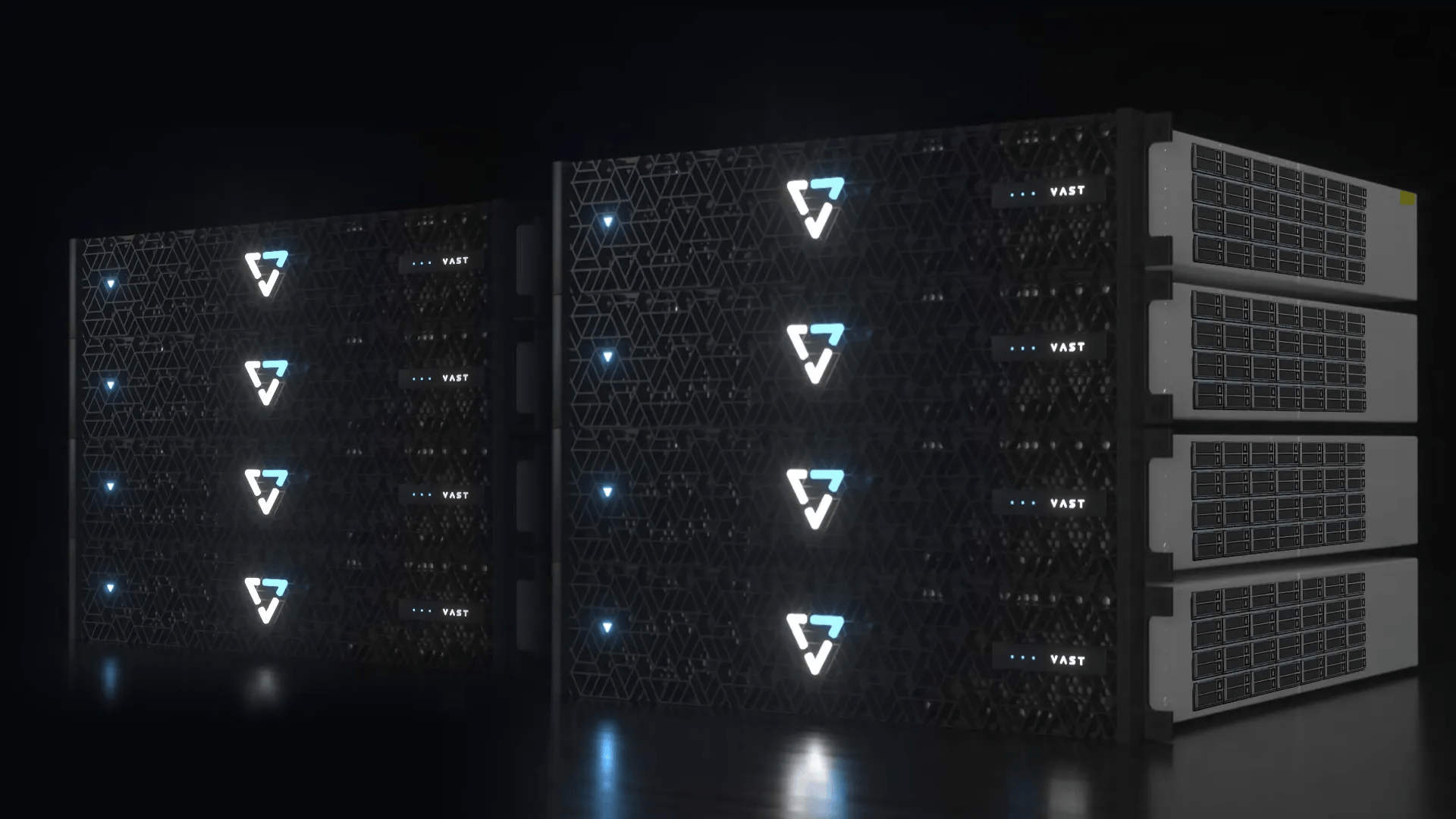
VAST delivers a unified AI operating system that integrates storage, database, and compute into a platform for agentic AI and data-intensive applications. Intended to support massive GPU clusters and complex AI workflows, the VAST AI OS eliminates traditional infrastructure silos that slow down innovation.
Key features include:
- Integrated AI operating system: Combines storage, compute, and database to support AI agent workflows end-to-end
- DASE architecture for parallelism: Enables TB/s throughput and scales to over 100K GPUs without I/O bottlenecks
- Exabyte-scale flash storage: Provides long-term memory for AI, storing all data types (images, video, text, events) for instant access
- Global namespace and API: Offers unified data and compute access from edge to cloud under a single control plane
- Enterprise reliability and security: Built-in multi-tenancy, granular access controls, automation, and real-time auditing

4. Google Coral Edge TPU


The Google Coral Edge TPU is a family of low-power, high-efficiency AI accelerators intended to bring fast machine learning inference to edge devices. At the core of the Coral platform is the Edge TPU, a purpose-built ASIC that accelerates TensorFlow Lite models directly on-device. Coral products range from development boards and USB accessories for prototyping to mini PCIe and M.2 modules for production deployment.
Key features include:
- Edge TPU accelerator: Specialized ASIC for fast, low-power neural network inference
- TensorFlow Lite support: Optimized for models designed with TensorFlow Lite and TFLite Micro
- Versatile form factors: Includes USB, M.2, mini PCIe, and system-on-module options for prototyping and deployment
- Cross-platform compatibility: Works with Linux, macOS, Windows 10, and Raspberry Pi environments
- Low power consumption: Enables real-time AI processing in power-constrained and embedded systems
5. Axelera AI Metis


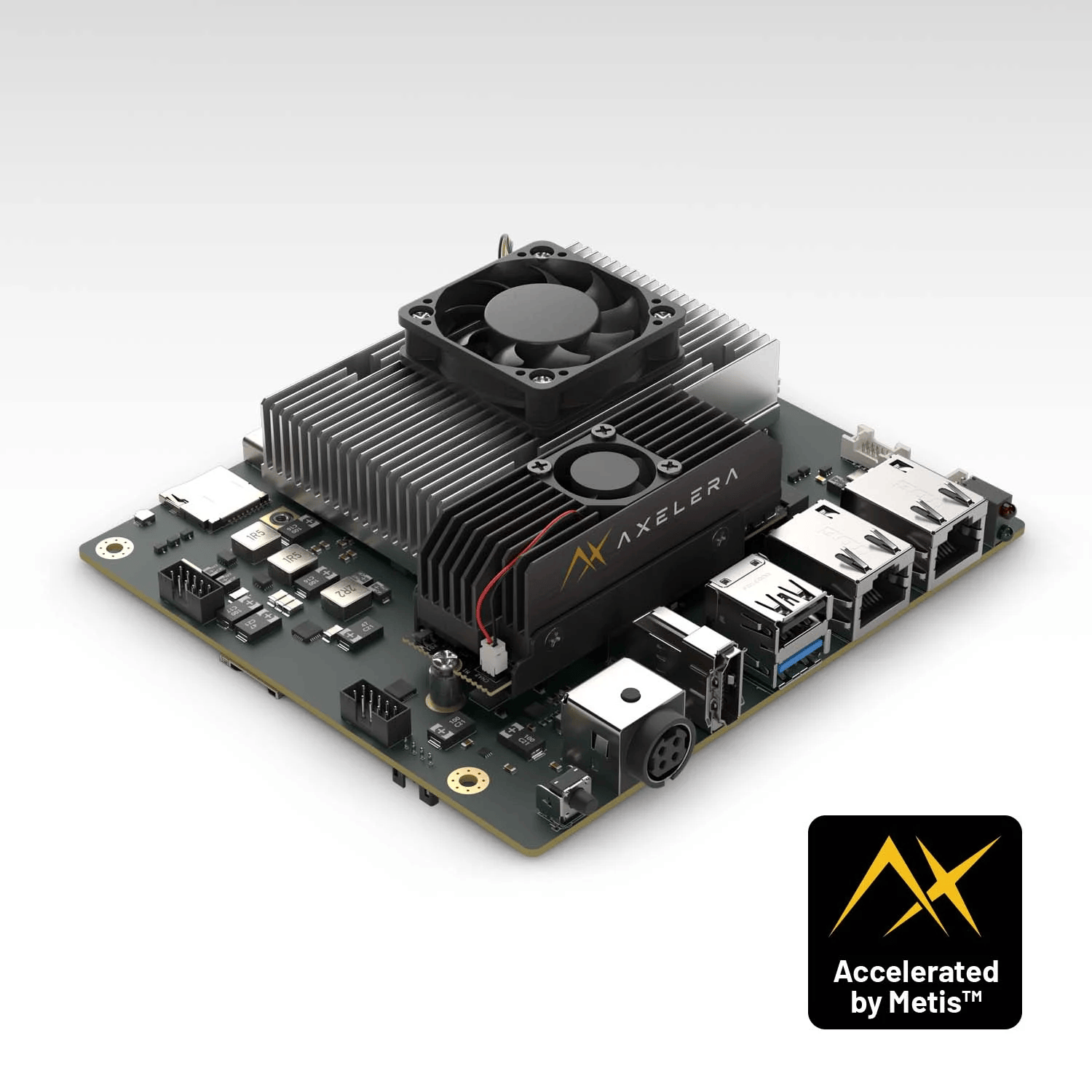
Axelera AI’s Metis is an AI processing unit (AIPU) to deliver high-performance computer vision inference at the edge, without the cost and scalability constraints of traditional cloud-based solutions. Designed specifically for edge deployment, Metis delivers up to 214 TOPS of INT8 performance and achieves industry-leading efficiency at 15 TOPS/W.
Key features include:
- Up to 214 INT8 TOPS per AIPU: Delivers high-density compute in compact form factors
- 15 TOPS/W energy efficiency: Enables AI inference while keeping power consumption low (typical use ~10W)
- High inference throughput: Up to 3200 FPS on ResNet-50 with top-tier FPS/Watt ratios
- Record-setting FPS per dollar: Achieves 16.4 FPS/$ on ResNet-50v1, optimized for cost-effective edge AI at scale
- Voyager SDK: Streamlined software platform for fast development, deployment, and scalability, no retraining required

6. Hailo-10H Edge AI Accelerator


The Hailo-10H is a second-generation edge AI accelerator that brings generative AI capabilities to edge devices. With 40 TOPS of INT4 performance and power efficiency, it enables execution of large AI models, including LLMs, VLMs, and diffusion-based architectures, without relying on cloud infrastructure.
Key features include:
- 40 INT4 / 20 INT8 TOPS: High-performance compute for vision and generative AI at the edge
- Second-gen neural core architecture: Enhanced scalability and efficiency for running large models
- DDR memory interface: Supports complex workloads like LLMs and Stable Diffusion with high memory bandwidth
- 2.5W typical power consumption: Enables always-on operation with minimal energy usage
- Offline AI capability: Supports real-time inference with low latency and no cloud dependency
High-Performance Edge AI SoCs and Compute Modules
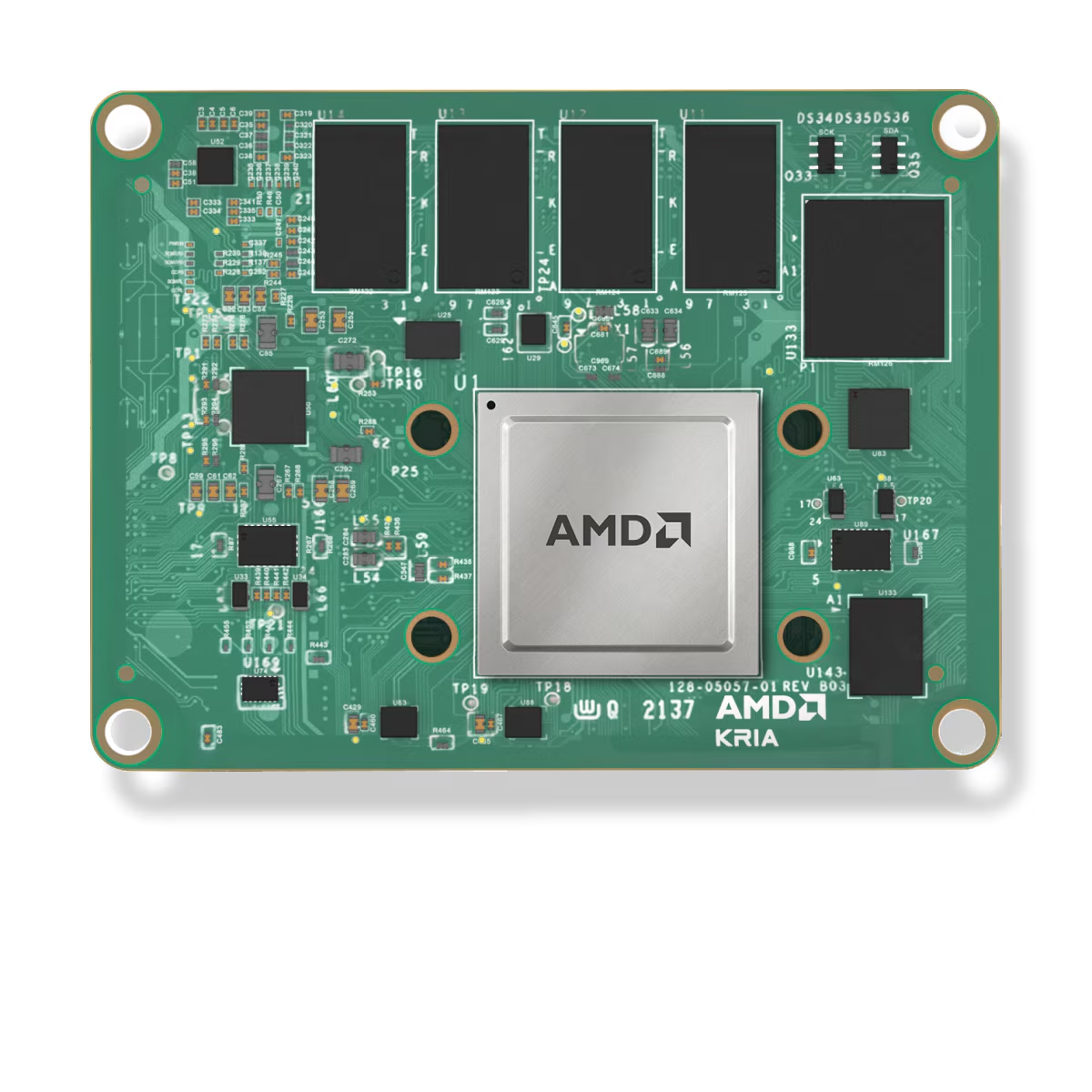
7. AMD Xilinx Kria K26


The AMD Xilinx Kria K26 is a production-ready system-on-module (SOM) optimized for vision AI, robotics, and industrial edge deployments. Built on the Zynq UltraScale+ MPSoC architecture, the K26 delivers higher vision AI performance better performance-per-watt compared to competing SOMs.
Key features include:
- Zynq UltraScale+ MPSoC architecture: Combines programmable logic and multi-core processing in a compact SOM
- 3× vision AI performance vs. competing SOMs: Optimized for smart camera and embedded vision workloads
- Out-of-the-box acceleration: Run pre-built AI and vision pipelines without FPGA place-and-route
- Native ROS 2 support: Enables rapid robotics development with up to 5× productivity gains
- Commercial and industrial grades: Operating ranges from 0–85°C (commercial) to -40–100°C (industrial)
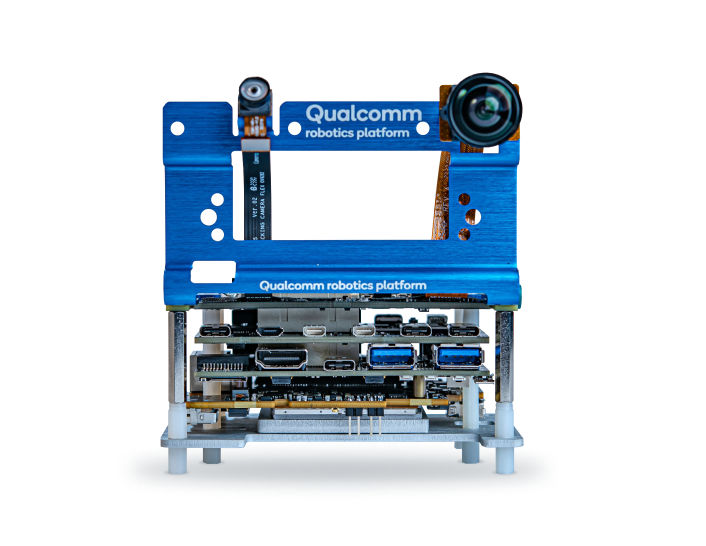
8. Qualcomm Robotics RB5 Platform


The Qualcomm Robotics RB5 platform is an integrated edge AI solution for robotics and IoT applications. Powered by the 5th generation Qualcomm AI Engine and Kryo octa-core CPUs, RB5 combines high-performance compute, on-device AI, and computer vision capabilities in a power-efficient design. It supports up to seven simultaneous camera inputs, 8K video capture, and an array of sensors.
Key features include:
- On-device AI with Qualcomm AI Engine: Supports deep learning and inference workloads at the edge
- Octa-Core Kryo CPUs and Adreno GPU: Enables heterogeneous computing for real-time robotics applications
- Multi-camera vision support: Handles up to 7 cameras with 8K video capture and computer vision pipelines
- Pre-integrated sensor and motor interfaces: Simplifies development with ready-to-use drivers and control systems
- 5G and Wi-Fi 6 connectivity: Supports high-speed wireless communication, including mmWave and sub-6 GHz bands

Best Practices for Selecting Edge AI Hardware
Here are some useful points to consider when evaluating hardware for edge AI use cases.
1. Match Model Complexity to Power Budget
Selecting the right edge AI hardware starts with harmonizing the complexity of AI models with the available power budget. Sophisticated deep learning models generally demand higher compute resources and therefore increase both power consumption and thermal requirements.
Matching simpler models like quantized neural networks or classical machine learning algorithms to ultra-low power chips extends battery life and lowers overall system costs in edge scenarios. For battery-powered devices or environments with limited power infrastructure, prioritize hardware capable of running the simplest model that meets performance objectives.
2. Evaluate Software Ecosystem Maturity
A mature software ecosystem is vital for accelerating integration, optimizing performance, and ensuring sustainable support for edge AI deployments. Hardware should come with well-maintained SDKs, precompiled libraries, and deep learning framework compatibility, reducing friction across the development pipeline.
Look for documentation, active developer communities, and vendor commitment to long-term software updates. Evaluate the breadth and quality of hardware abstraction layers, driver support, and tools for model conversion or optimization. Integration with DevOps and CI/CD pipelines, along with simulation or remote debugging tools, can dramatically simplify testing and maintenance.
3. Plan for Thermal and Mechanical Constraints
Thermal and mechanical constraints affect the reliability of edge AI systems. Devices deployed in the field may be subject to temperature extremes, vibration, humidity, and enclosure limitations, all of which can impair thermal dissipation and mechanical integrity. Choosing hardware with appropriate TDP ratings and thermal management features, such as heat sinks, spreaders, or fanless cooling options, prevents performance throttling and system failures.
Mechanical factors like board dimensions, mounting options, ingress protection, and connector durability impact both the initial deployment but also serviceability over time. Prioritize modules or kits that provide comprehensive design documentation and validated environmental robustness. Pilot in-situ tests are essential to verify that edge AI hardware meets demands.
4. Design for Long-Term Availability
Long-term hardware availability is critical, particularly for industrial, automotive, and medical edge AI deployments where products remain in service for many years. Prioritize hardware platforms with clear vendor roadmaps, guaranteed lifecycle support, and published end-of-life (EOL) schedules. This reduces cost and risk associated with redesigns or qualification of replacement components.
Additionally, select hardware with community or industry backing, increasing the likelihood of ecosystem support and compatibility with next-generation modules. Modular form factors and pin-compatible upgrades further ease transitions when hardware obsolescence occurs. Early engagement with vendors for supply chain transparency can prevent downtime down the line.
5. Validate Security and Update Capabilities
Security is non-negotiable for edge AI hardware that handles sensitive data or operations. Prioritize solutions with features such as secure boot, hardware root-of-trust, encrypted storage, and hardware-based isolation for sensitive workloads. Hardware should support regular firmware and software updates, including over-the-air (OTA) mechanisms, to address vulnerabilities throughout the device lifecycle.
Update capabilities are crucial for maintaining compliance, patching security flaws, and delivering functional improvements. Validate that hardware vendors provide signed updates, rollback protections, and documentation on safe update processes in distributed deployments.