


Request a Demo
Join a 30 minute demo with a Cloudian expert.
TL;DR: Immutable storage locks records in a non-rewriteable, non-erasable state for a fixed retention period so regulated data can be proven unaltered. Cloudian HyperStore is best for on-prem compliance archives, Dell ObjectScale exascale estates, Amazon S3 cloud-native workloads, and Wasabi low-cost immutable backup.
Immutable storage refers to a data storage architecture where information, once written, cannot be altered or deleted for a specified retention period. The key attribute is that data remains in its original state, protecting it from accidental or malicious modification. Immutable storage is widely used in sectors where data integrity and traceability are essential, such as finance, healthcare, and legal services.
Choosing enterprise immutable storage for regulatory compliance involves deploying Write-Once-Read-Many (WORM) technology or object locks that physically or logically prevent data alteration or deletion for a set time. This satisfies strict legal mandates across finance, healthcare, and public sectors by guaranteeing unalterable audit trails and data integrity.
Key evaluation criteria in regulated environments:
The criteria below are the ones that separate platforms once basic WORM support is assumed:
Solutions covered in this guide:
In this article;
Maintaining the integrity of business records is a core requirement for regulatory compliance. Immutable storage ensures that once records are saved, they cannot be changed or deleted, regardless of user permissions or system vulnerabilities. This guarantees that the original versions of records are preserved, enabling organizations to prove the authenticity and accuracy of their data. This level of assurance is critical for meeting legal obligations and defending against disputes or investigations in regulated industries, such as:
The ability to protect data integrity through immutability also helps enterprises build trust with stakeholders, including customers, partners, and regulators. When records cannot be altered retroactively, organizations can demonstrate that their data management practices are robust and transparent. This not only reduces the risk of non-compliance penalties but also strengthens the organization’s reputation for responsible data stewardship.
Many regulations require organizations to retain data for predefined periods, often spanning several years. Immutable storage provides a reliable mechanism to enforce these retention periods by preventing premature deletion or alteration of records. Automated retention controls can be configured to lock data for the required duration, ensuring compliance with laws such as
This eliminates the risk of accidental or intentional data loss that could result in regulatory violations and costly penalties. By leveraging immutable storage, enterprises can efficiently manage large volumes of regulated data without the operational overhead of manual monitoring and enforcement. Retention policies are applied systematically, reducing administrative errors and ensuring consistency across diverse data sets.
Audits and investigations require organizations to produce original, unaltered records that accurately reflect historical events or transactions. Immutable storage ensures that these records are preserved in their original form, free from tampering or unauthorized modification. This capability is essential for demonstrating compliance during:
Immutable storage also simplifies the process of locating and retrieving relevant records, reducing the time and effort required to respond to requests. Maintaining immutable records provides a defensible audit trail, which is often a regulatory requirement in itself. Auditors and investigators can trace the lifecycle of each record, from creation to retention and eventual disposition, with confidence that the data has not been manipulated.
Ransomware attacks and other forms of cybercrime often target critical business data, encrypting or destroying records to extort organizations. Immutable storage offers protection against these threats by preventing unauthorized changes or deletions, even if attackers gain access to storage systems. Once data is written to an immutable storage platform, it is locked and cannot be altered until the retention period expires. This ensures that clean copies of data are always available for recovery, minimizing the impact of ransomware incidents.
In addition to ransomware mitigation, immutable storage improves overall cybersecurity posture by reducing the attack surface for data manipulation. Security teams can leverage immutable storage as part of a layered defense strategy, ensuring that critical records remain protected from:
Immutable storage also supports incident response and forensic investigations by preserving unaltered evidence, enabling organizations to identify the source and scope of security breaches.
Related content: Read our guide to immutable backups
SEC Rule 17a-4 mandates that broker-dealers retain electronic records in a non-rewriteable, non-erasable format for specified periods. This requirement was established to ensure the integrity and accessibility of financial records, supporting regulatory oversight and investor protection. Immutable storage technologies, such as WORM drives or object storage with retention policies, are explicitly referenced as compliant solutions under the rule.
Organizations must also maintain audit trails and be able to produce records promptly upon request from regulators. Implementing immutable storage in accordance with SEC Rule 17a-4 helps financial firms avoid significant fines and enforcement actions. The rule’s strict requirements for data retention, integrity, and accessibility make manual or ad-hoc solutions insufficient for compliance.
The Financial Industry Regulatory Authority (FINRA) imposes stringent recordkeeping requirements on member firms, covering a wide range of business communications and transactional data. FINRA rules specify that records must be preserved in a format that prevents alteration or destruction, aligning closely with the principles of immutable storage. Firms are required to implement controls that ensure records remain accessible and unmodified for the duration of mandated retention periods.
Adopting immutable storage solutions helps FINRA-regulated organizations address these requirements efficiently. Automated retention policies and tamper-evident storage architectures provide verifiable assurance that records have not been altered or deleted. This not only supports regulatory compliance but also simplifies audit preparation and response. Firms can demonstrate a proactive approach to data integrity and governance.
The Health Insurance Portability and Accountability Act (HIPAA) establishes strict requirements for the retention and protection of electronic health records (EHRs) and other patient information. HIPAA mandates that covered entities implement safeguards to ensure the confidentiality, integrity, and availability of protected health information (PHI). Immutable storage meets these requirements by preventing unauthorized modification or deletion of records, providing a secure foundation for healthcare data management.
By implementing immutable storage, healthcare organizations can demonstrate compliance with HIPAA’s Security and Privacy Rules. Automated retention controls and audit trails help ensure that PHI is preserved in its original form, supporting both regulatory audits and patient trust. Immutable storage also improves the organization’s ability to recover from data breaches or ransomware attacks, minimizing the risk of data loss and regulatory penalties
Related content: Read our guide to HIPAA compliant cloud storage
The General Data Protection Regulation (GDPR) and the EU’s NIS2 Directive impose rigorous data protection and cybersecurity obligations on organizations operating in Europe. GDPR requires that personal data be processed securely and that its integrity is maintained throughout its lifecycle. Immutable storage supports these objectives by providing technical controls to prevent unauthorized alteration or deletion of personal data. This is particularly important for demonstrating compliance with GDPR’s accountability and data integrity principles.
NIS2, aimed at enhancing the security of network and information systems, requires organizations to implement cybersecurity measures, including protection against data loss and tampering. Immutable storage solutions help organizations meet these requirements by ensuring that critical records and logs cannot be altered or erased, even in the event of a cyberattack.
The Sarbanes-Oxley Act (SOX) requires publicly traded companies to retain financial records and supporting documentation for specified periods, ensuring transparency and accountability in financial reporting. SOX mandates that records be preserved in a manner that prevents alteration or destruction, making immutable storage an effective solution for compliance. By enforcing retention periods and preventing tampering, immutable storage helps organizations maintain accurate financial records and withstand regulatory scrutiny.
In addition to supporting recordkeeping requirements, immutable storage enables SOX compliance by providing reliable audit trails and verifiable evidence of data integrity. Organizations can demonstrate that financial records have not been altered, supporting both internal controls and external audits. This reduces the risk of compliance failures, financial restatements, and associated penalties.
The six criteria below apply across both on-premises platforms and cloud services. Working through them in order tends to eliminate unsuitable options quickly, because certification and retention semantics are pass/fail for most regulated workloads while cost and integration are matters of degree.
Auditors and regulators generally look for evidence that a storage system has been assessed against the rule in question, not a general claim of compliance. Third-party assessment firms publish reports covering SEC Rule 17a-4(f), FINRA Rule 4511, CFTC Regulation 1.31(c)-(d) and, in Europe, MiFID II and IDW PS 880. A platform without a named assessment may still be technically capable, but the organization carries the burden of proving that in an audit.
Evaluation criteria:
WORM support varies more than the acronym suggests. Most S3-compatible platforms offer two retention modes: a governance-style mode where privileged accounts can shorten or remove a lock, and a compliance-style mode where no account, including the root account, can do so. Regulated retention almost always requires the stricter mode. Legal hold, which has no expiry and is lifted explicitly, is a separate control needed for litigation.
Evaluation criteria:
Immutability is only half of a defensible record. The other half is a log showing when an object was written, what retention was applied, who attempted to change it, and what the system did in response. Some platforms keep dedicated WORM audit logs; others rely on general-purpose activity logging that must be exported to a SIEM. The difference matters when an auditor asks for chain of custody.
Evaluation criteria:
Retention obligations frequently come with residency obligations. Some organizations cannot place regulated records in a shared public cloud at all; others need a specific region or a dedicated data perimeter. On-premises and hybrid platforms give direct control over physical location, while cloud services address this through region selection, dedicated zones, or on-premises extensions.
Evaluation criteria:
Most immutable storage is written by something else, usually backup or archive software. Full S3 Object Lock API fidelity determines whether that software can set retention correctly, and vendor validation programs determine whether the combination is supported when something fails. Partial API coverage tends to surface only after deployment.
Evaluation criteria:
Multi-year retention means paying for data that cannot be deleted early, so the cost model compounds. Cloud services add egress, API request and minimum storage duration charges that are easy to underestimate across a seven-year hold. On-premises platforms shift the cost to capacity, erasure coding overhead and refresh cycles.
Evaluation criteria:
The table below summarizes how each platform measures up against the criteria above. Each solution is covered in detail in the following section.
| Category | Solution | How It Meets the Criteria |
| On-premises and hybrid immutable object storage | Cloudian HyperStore | Object Lock with Compatible and Certified retention modes plus legal hold, assessed against SEC 17a-4(f), FINRA 4511, CFTC 1.31(c)-(d) and IDW PS 880, with dedicated WORM audit logging and FIPS 140-3 Level 1 validated cryptography. |
| On-premises and hybrid immutable object storage | Dell ObjectScale | ObjectLock WORM alongside erasure coding and replication, stated conformance with SEC 17a-4-f, FINRA and GDPR, and exascale capacity across X560 and all-flash XF960 nodes. |
| On-premises and hybrid immutable object storage | NetApp StorageGRID | S3 Object Lock combined with a policy-driven ILM engine for automated placement and retention, multi-admin verification, and deployment on appliances, VMs or containers. |
| On-premises and hybrid immutable object storage | Hitachi Vantara Object Storage | Built-in immutability with HCP validated by Cohasset Associates for SEC, FINRA, CFTC and MiFID II, plus PII Discovery and appliance, software-defined or as-a-service deployment. |
| Cloud object storage with immutability controls | Amazon S3 | Object Lock in governance or compliance mode with Retain Until Date and Legal Hold, WORM status reporting via S3 Inventory, CloudTrail activity logging, and data perimeter options through Dedicated Local Zones and Outposts. |
| Cloud object storage with immutability controls | Azure Blob Storage | Immutable WORM storage with policy-based access control and lifecycle management, Entra ID and RBAC, and a large portfolio of compliance certifications including region-specific ones. |
| Cloud object storage with immutability controls | Wasabi Hot Cloud Storage | Object Lock and immutable buckets in compliance or governance mode at no additional charge, with a flat per-TB rate and validation for Veeam Backup and Replication. |
| Cloud object storage with immutability controls | Backblaze B2 Cloud Storage | Object Lock providing real-time WORM, bucket access logs and fine-grained API keys, with SOC 2 Type 2, HIPAA BAAs and TX-RAMP among its compliance supports. |
Related content: Read our article about the best immutable storage for enterprise
How we selected these solutions: We shortlisted object storage platforms and cloud storage services that provide WORM or Object Lock immutability, configurable retention periods and legal hold, audit logging, and integration with enterprise backup and archive software.

Best for: On-prem and hybrid compliance archives needing certified immutability
Strengths: Object Lock with WORM audit logs and FIPS 140-3 validated cryptography
Things to consider: Monitoring and reporting interface takes extra steps to navigate
Cloudian HyperStore is a software-defined, S3-compatible object storage platform available as standalone software or as Cloudian appliances. It applies a multi-layered security architecture spanning the hardware layer, identity and access management, encryption and active ransomware defense.
For regulated data, HyperStore supports Write Once, Read Many through S3 Object Lock, holding objects in an immutable state that no user, including the root administrator, can alter or delete until the retention period expires. Both Object Lock retention modes, Compatible and Certified, are supported alongside Legal Hold.
Key features include:
| Criterion | Solution Fit | Key Considerations |
| Regulatory certification and validation | Object Lock independently assessed for SEC 17a-4(f), FINRA 4511, CFTC 1.31(c)-(d) and IDW PS 880; FIPS 140-3 Level 1 validated cryptographic module. | Assessments apply to the Object Lock feature as configured; confirm the deployed version matches the assessed one. |
| WORM enforcement and retention controls | Both Compatible and Certified Object Lock retention modes, plus Legal Hold; locked objects cannot be altered or deleted by any user including the root administrator. | Standard S3 Object Lock prerequisites apply, including versioned buckets. |
| Audit trails and evidentiary support | Dedicated WORM audit logs record retention actions and unauthorized deletion attempts, retained under the configured retention policy; secure delete operations are separately auditable. | Reviewers note the monitoring and reporting interface can take extra steps to reach specific details. |
| Deployment model and data sovereignty | Standalone software or appliances on servers, VMs or containers, on-premises or hybrid, with a single flat S3 namespace across sites and per-bucket placement policies. | Multi-site and tiering configurations need planning to keep locked copies within required jurisdictions. |
| Backup and application ecosystem integration | Full S3 API compatibility using the AWS S3 SDK, with unified file and object services for applications requiring SMB or NFS. | Advanced configuration may benefit from vendor guidance; reviewers describe documentation for advanced setups as an area for improvement. |
| Long-term retention cost and scalability | Modular architecture with non-disruptive expansion and linear scaling; runs on industry-standard hardware, with per-bucket erasure coding to balance overhead against fault tolerance. | Erasure coding overhead should be modelled against multi-year retention volumes when sizing. |
Best for: Exascale on-prem object estates consolidating archive and AI data
Strengths: ObjectLock WORM with stated SEC 17a-4-f, FINRA and GDPR conformance
Things to consider: S3 API coverage and documentation are cited as improvement areas
Dell ObjectScale is an enterprise object storage platform built on an exascale architecture, positioned for large-scale data collection, GenAI training, content delivery, backup and archiving. It is available as a software update for existing ECS environments, and ObjectScale nodes can be integrated with existing ECS clusters.
Data protection is offered through three schemes: erasure coding for storage efficiency, replication for resilience, and ObjectLock WORM for immutability. Dell states that ObjectScale complies with TLS 1.3, SEC 17a-4-f, FINRA and GDPR, and follows the CISA KEV patch cadence.
Key features include:
| Criterion | Solution Fit | Key Considerations |
| Regulatory certification and validation | Stated compliance with SEC 17a-4-f, FINRA and GDPR, plus TLS 1.3 and CISA KEV patch cadence. | Compliance is stated on the product page rather than presented as a linked third-party assessment; request the underlying report. |
| WORM enforcement and retention controls | ObjectLock WORM ensures immutability for compliance, offered alongside erasure coding and replication. | Retention mode and legal hold detail is not covered on the product page and should be confirmed with Dell. |
| Audit trails and evidentiary support | Not addressed on the product page. | Reviewers on PeerSpot describe reporting as an area for improvement, and disaster recovery and search as functions users would prefer built in. |
| Deployment model and data sovereignty | On-premises deployment across X560 and XF960 nodes, delivered as software or appliances, with a unified global namespace and Azure Blob integration for hybrid strategies. | Reviewers note limited cloud-version availability and that appliance purchases bundle hardware. |
| Backup and application ecosystem integration | Comprehensive S3 APIs with a global namespace, and integration across the Dell portfolio including PowerScale and Data Domain. | Reviewers report S3 API coverage is not complete and that third-party integration and documentation need improvement. |
| Long-term retention cost and scalability | Up to 9.2 PB raw per rack on X560 and 47.2 PB on XF960, with smart rebalancing on node addition or retirement; Dell cites up to 76% lower TCO than public cloud. | Reviewers frequently describe the platform as expensive and ask for more flexible, pay-per-use licensing. |

Best for: Distributed estates needing policy-driven retention across many sites
Strengths: ILM policy engine paired with S3 Object Lock and multi-admin verification
Things to consider: Initial setup and network design require experienced storage staff
NetApp StorageGRID is a software-defined object storage suite supporting public, private and hybrid multicloud environments, with native support for the Amazon S3 API. It manages globally distributed data as a single system under a unified namespace.
For governance, StorageGRID uses a dynamic policy engine driven by information lifecycle management rules, automating data placement and retention across distributed environments to address privacy, security and regulatory compliance requirements. S3 Object Lock extends immutability for long-term retention, helping prevent deletion, modification or encryption and enabling restore to a known-good state.
Key features include:
| Criterion | Solution Fit | Key Considerations |
| Regulatory certification and validation | The platform is positioned for compliance-driven datasets with secure, auditable storage, encryption, access controls and automated retention policies. | The product page does not name specific rules; ask NetApp for the Cohasset assessment covering the deployed version. |
| WORM enforcement and retention controls | S3 Object Lock extends immutability for long-term retention, preventing deletion, modification or encryption, backed by ILM rules that apply retention automatically. | Retention mode behaviour and legal hold detail are not described on the product page. |
| Audit trails and evidentiary support | Multi-admin verification in 12.1 adds governance controls over administrative actions; secure, auditable storage is cited as a compliance capability. | Reviewers note that surfacing some details can require experienced staff, and one reports being unable to copy synchronously to a Cloud Storage Pool or Archive Node. |
| Deployment model and data sovereignty | Appliances, VMs, Docker containers or a mix, across public, private and hybrid multicloud, with a unified namespace and Grid Federation across systems. | Reviewers report that initial setup and network design take significant time to make fully compatible with enterprise needs. |
| Backup and application ecosystem integration | Native Amazon S3 API support with validated backup integrations including Veeam, plus tiering and integration with NetApp Console. | One reviewer describes replication features to other cloud vendors as limited. |
| Long-term retention cost and scalability | Scales object capacity across sites without disrupting applications, with metadata-driven tiering to reduce cost and an appliance range up to 1,475 TB raw. | Reviewers describe overall cost as high and note erasure coding overhead, with one citing 600 TB raw producing 250 TB usable. |

Best for: Banking and regulated archives needing MiFID II and SEC coverage
Strengths: HCP validated by Cohasset for SEC, FINRA, CFTC and MiFID II
Things to consider: Administration interface is described as complex by reviewers
Hitachi Vantara’s object storage portfolio spans Virtual Storage Platform One Object, a software-defined microservices-based platform, and Hitachi Content Platform, the longer-established archive system. VSP One Object supports billions of objects, integrates with QLC-based VSP One Block midrange systems, and includes intelligent services such as PII Discovery to identify and govern sensitive data across stored objects.
For regulated retention, HCP is validated by Cohasset Associates for compliance with SEC, FINRA, CFTC and MiFID II mandates, which makes the portfolio relevant to organizations with both US and European obligations.
The security architecture is multi-layered and aligned to frameworks such as NIST 2.0, combining built-in immutability with zero-trust security models and integrations with backup and recovery partners including Commvault and Veeam.
Key features include:
| Criterion | Solution Fit | Key Considerations |
| Regulatory certification and validation | HCP is validated by Cohasset Associates for SEC, FINRA, CFTC and MiFID II, giving coverage across US and European mandates. | Validation is stated for HCP; confirm which assessments extend to VSP One Object deployments. |
| WORM enforcement and retention controls | Built-in immutability across the object storage line, positioned for retention and audit requirements alongside ransomware resilience. | Retention modes and legal hold behaviour are not detailed on the product page. |
| Audit trails and evidentiary support | Data governance capabilities are positioned to keep data available, protected and auditable, with PII Discovery adding automated classification. | Reviewers on PeerSpot specifically cite log tracking for access as an area still needing improvement. |
| Deployment model and data sovereignty | Appliance-based, software-defined and as-a-service options across on-premises and hybrid, including disaggregated deployments on VSP One Block midrange or HDD S-Nodes. | Reviewers describe migration from existing systems as lacking a simple process. |
| Backup and application ecosystem integration | S3-native APIs with integrations across backup and recovery partners including Commvault and Veeam, plus native S3 Table support. | Reviewers report that integration with other platforms and clouds needs improvement, and that NFS requires an additional gateway. |
| Long-term retention cost and scalability | Supports billions of objects with claimed rack space reductions of 50 to 70% and up to 50% better power efficiency at comparable capacity. | Reviewers describe pricing as an issue and ask for more cost-effective licensing; support quality is reported to vary by country. |

Best for: Cloud-native regulated workloads already running in AWS
Strengths: Compliance-mode Object Lock with WORM status reporting via S3 Inventory
Things to consider: Pricing across classes, retrieval and requests is hard to forecast
Amazon S3 provides WORM enforcement through S3 Object Lock, a management feature that blocks object version deletion during a customer-defined retention period. Workloads can be migrated from existing WORM systems into S3, with Object Lock configured at object and bucket level to prevent deletions before a pre-defined Retain Until Date or Legal Hold Date.
Object Lock protection persists even when objects move between storage classes under an S3 Lifecycle policy. To track which objects are protected, an S3 Inventory report includes the WORM status of objects.
Two modes are available. Governance mode allows AWS accounts with some IAM permissions to remove Object Lock from objects. Compliance mode is intended where stronger immutability is required to comply with regulations, and protection cannot be removed by any user, including the root account.
Key features include:
| Criterion | Solution Fit | Key Considerations |
| Regulatory certification and validation | Compliance mode is positioned for regulatory requirements that mandate WORM storage, with migration paths from existing WORM systems. | The features page does not name the assessment; the associated Cohasset report should be obtained separately. |
| WORM enforcement and retention controls | Governance and compliance modes, object- and bucket-level configuration, Retain Until Date and Legal Hold Date, with protection preserved across storage class transitions. | Compliance mode is deliberately unforgiving; retention set in error cannot be shortened, which makes policy testing important. |
| Audit trails and evidentiary support | CloudTrail bucket- and object-level activity tracking, server access logs, S3 Inventory WORM status reports and Event Notifications, plus stored checksums for integrity verification. | Assembling an audit package spans several services rather than a single retention log. |
| Deployment model and data sovereignty | Region selection plus Dedicated Local Zones, Local Zones and S3 on Outposts for data perimeter requirements that Regions cannot meet. | Reviewers note that some features are restricted by location, which can complicate consistent policy across regions. |
| Backup and application ecosystem integration | The reference S3 Object Lock implementation that most backup and archive vendors target, with broad SDK, CLI and console support. | Reviewers describe permissions and bucket policy management as complex and error-prone without experience. |
| Long-term retention cost and scalability | Nine storage classes with Lifecycle transitions and Storage Class Analysis to move aging data to lower-cost archival tiers. | Reviewers consistently describe pricing as confusing and hard to predict once retrieval, transfer and request fees are combined. |

Best for: Microsoft-centric estates needing WORM inside existing Azure governance
Strengths: Immutable WORM storage with Entra ID, RBAC and broad certifications
Things to consider: Cost structure across transactions and retrieval complicates forecasting
Azure Blob Storage is Microsoft’s object storage service for cloud-native workloads, archives, data lakes, HPC and machine learning. Its data management capabilities include end-to-end lifecycle management, policy-based access control and immutable write once, read many storage.
Security is handled through authentication with Microsoft Entra ID and role-based access control, encryption at rest and advanced threat protection. Data in Azure Storage is encrypted and decrypted transparently using 256-bit AES encryption and is FIPS 140-2 compliant.
For long-retention archives, four access tiers are available: Premium for performance-sensitive data, Hot for frequently accessed data, Cool and Cold for infrequently accessed data, and Archive for rarely accessed data. Microsoft cites more than 100 compliance certifications, including over 50 specific to global regions and countries.
Key features include:
| Criterion | Solution Fit | Key Considerations |
| Regulatory certification and validation | More than 100 compliance certifications, including over 50 specific to global regions and countries, plus FIPS 140-2 compliant encryption. | The product page lists certification breadth rather than named WORM assessments for specific financial rules. |
| WORM enforcement and retention controls | Immutable write once, read many storage is provided alongside policy-based access control and lifecycle management. | Retention mode and legal hold detail sits outside the product page and needs confirming before designing a retention policy. |
| Audit trails and evidentiary support | Advanced threat protection and policy-based access control are provided; Azure Storage Discovery gives enterprise-wide visibility across the Blob Storage estate. | Retention-specific audit logging is not described on the product page. |
| Deployment model and data sovereignty | Region selection across Azure’s datacenter regions, with certifications specific to particular countries supporting residency requirements. | Cloud-only; there is no on-premises deployment of the service itself for organizations that cannot place records in public cloud. |
| Backup and application ecosystem integration | Supports common development frameworks including Java, .NET, Python and Node.js, and is widely used as a target by third-party storage and backup products. | Reviewers report that integrating Blob Storage with third-party tools often requires custom scripts. |
| Long-term retention cost and scalability | Five access tiers with automated lifecycle management and reserved capacity for cost reduction across long retention periods. | Reviewers describe the cost structure as confusing to forecast given storage, transaction, retrieval and geo-redundancy charges, and note data transfer costs can rise sharply. |
Best for: Cost-predictable offsite immutable backup and archive copies
Strengths: Object Lock and immutable buckets at no additional charge, Veeam verified
Things to consider: Object Lock must be enabled at bucket creation, not retrofitted
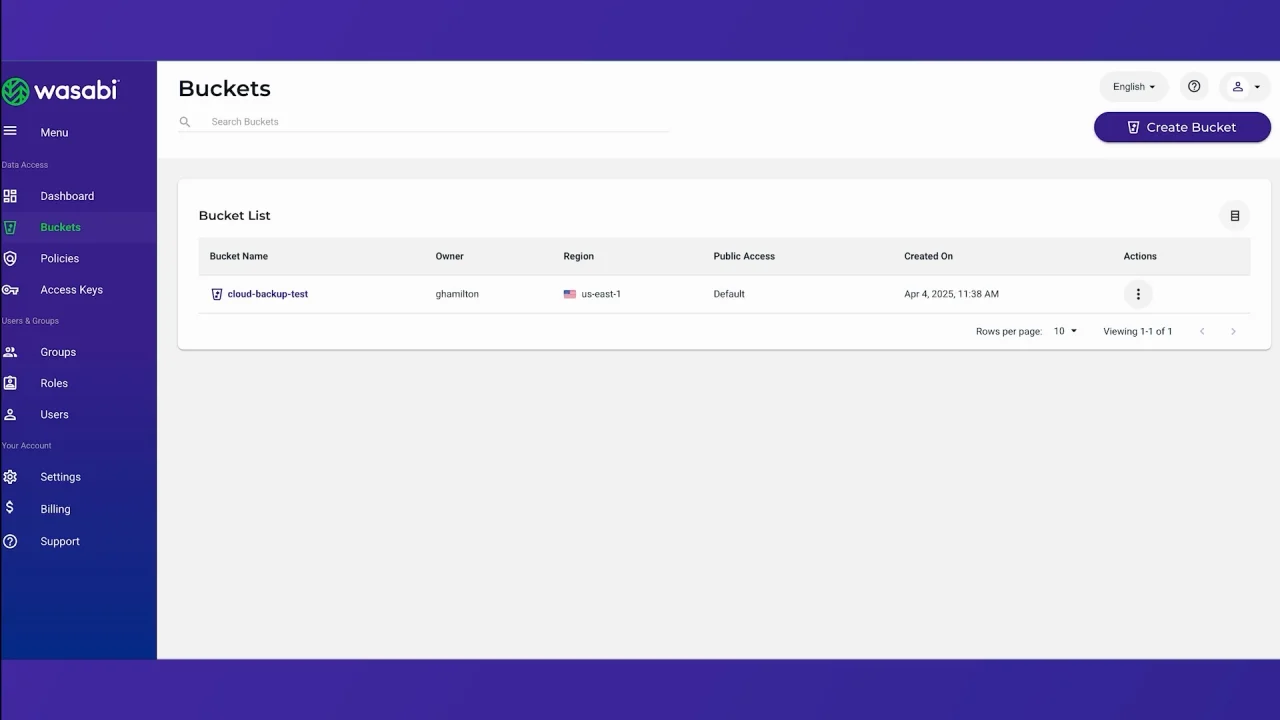
Wasabi Object Lock provides immutable cloud storage that remains immediately available rather than requiring restore from offline media. Immutable objects, locked individually or as part of a broader bucket policy, cannot be deleted or altered in any way, including by a system administrator.
Wasabi offers two approaches. Object Lock allows immutability and retention periods to be customized for each individual object, which suits data that changes over its lifetime such as backup data. Immutable buckets apply the same immutability and retention settings to all objects, which suits archives and long-term primary data.
The service is positioned for chain of custody and regulatory compliance, helping meet multi-year retention requirements for HIPAA, SEC, FINRA, FERPA and CJIS. Pricing is a flat rate starting at $7.99 per TB per month, with no additional charge for Object Lock and no API request charges to enable it or recover data.
Key features include:
| Criterion | Solution Fit | Key Considerations |
| Regulatory certification and validation | Positioned to help meet multi-year retention requirements for HIPAA, SEC, FINRA, FERPA and CJIS, and to support chain of custody. | The page states which regulations Object Lock helps address rather than citing a named third-party assessment. |
| WORM enforcement and retention controls | Compliance mode blocks overwrite by any user including Wasabi engineers and prevents retention dates being shortened; governance mode allows reduction only by specially permitted users; per-object and per-bucket options. | Object Lock must be enabled at bucket creation and requires versioning; it cannot be applied to an existing bucket. |
| Audit trails and evidentiary support | Chain of custody is cited as a use case, supported by immutability that no account can override. | Retention-specific audit logging is not described on the product page. |
| Deployment model and data sovereignty | Cloud service with a choice of Wasabi storage regions, plus Cloud replication options referenced across the product line. | Cloud-only, and reviewers report an outage affecting a regional endpoint, so multi-region copies are worth planning. |
| Backup and application ecosystem integration | Compatible S3 Object Lock API with verification for Veeam Backup and Replication v10, v11 and v12 and a validated partner list. | Reviewers describe the management console and bucket permission tooling as technical and not always intuitive. |
| Long-term retention cost and scalability | Flat rate starting at $7.99 per TB per month with no added charges for Object Lock, no API request fees and no egress charges. | Reviewers report a minimum storage duration that means deleted data continues to be billed, and one notes deleting an immutable folder can be awkward. |

Best for: Straightforward immutable backup targets at predictable per-TB cost
Strengths: Real-time Object Lock WORM with bucket access logs and scoped API keys
Things to consider: Fewer data center regions than hyperscalers for residency needs
Backblaze B2 is an always-hot, S3-compatible cloud object storage service used for backup, active archive and application storage. Its security framework covers access management, data storage security and architecture and physical controls, including encryption and server-side encryption, Object Locks, fine-grained API key control, bucket access logs, CORS and multi-region data replication.
Object Lock provides write once, read many access in real time, so data cannot be encrypted, changed or deleted by bad actors once a retention policy applies.
On the compliance side, the service lists SOC 2 Type 2, the GovRAMP Progressing Security Snapshot program, TX-RAMP Provisional Authorization, HECVAT, BAAs for HIPAA and PCI DSS support, aimed at fulfilling data storage, retention and deletion policies.
Key features include:
| Criterion | Solution Fit | Key Considerations |
| Regulatory certification and validation | SOC 2 Type 2, GovRAMP Progressing Security Snapshot, TX-RAMP Provisional Authorization, HECVAT, BAAs for HIPAA and PCI DSS support. | The listed programs are broad security and sector attestations rather than a named SEC 17a-4(f) or FINRA WORM assessment. |
| WORM enforcement and retention controls | Object Lock provides write once, read many access in real time, preventing encryption, change or deletion for the retention period. | Retention mode detail is not covered on the product page; reviewers note retention policy behaviour could be better explained. |
| Audit trails and evidentiary support | Bucket access logs form part of the security framework, and Event Notifications generate alerts for data changes. | Reviewers report that CLI output formats make immutable file timestamp information awkward to read. |
| Deployment model and data sovereignty | Region selection at bucket creation with multi-region data replication and Cloud Replication rules for compliance and local access. | Reviewers note a smaller data center footprint than hyperscalers, which constrains residency choices. |
| Backup and application ecosystem integration | S3-compatible access through APIs, ISVs, CLI and web UI, with hundreds of pre-built integrations across backup platforms. | Reviewers report advanced tasks often require the API, and browsing very large buckets through the web interface is slow. |
| Long-term retention cost and scalability | Flat per-TB pricing with free egress up to three times monthly storage, no minimum storage duration penalties, and subsidized migration from legacy storage. | Reviewers report rate limiting during large transfers and describe emptying or deleting buckets as time-consuming. |

Immutable storage supports regulatory compliance by combining enforced retention, tamper-resistant records, auditability, and reliable long-term access. Organizations should evaluate whether retention controls can withstand privileged access, whether regulatory validations match their obligations, and whether audit logs provide sufficient evidence. Deployment location, application compatibility, scalability, and multi-year storage costs also need to be assessed before selecting an architecture for regulated data.

