


Request a Demo
Join a 30 minute demo with a Cloudian expert.
An AI data platform is a specialized big data environment designed to support artificial intelligence (AI) and machine learning (ML) workloads. These platforms provide the infrastructure and tools needed to collect, store, process, and analyze large volumes of diverse data. They enable the seamless integration of data from various sources and ensure it is accessible for AI and ML applications.
By providing a comprehensive ecosystem for data and AI, these platforms help organizations accelerate innovation, optimize operations, and gain competitive advantages through data-driven insights.
This is part of a series of articles about AI infrastructure
In this article:
A modern data platform supports AI-driven innovation, enabling organizations to efficiently manage and analyze their data. Traditional data management solutions cannot provide the scalability, flexibility, and analytical capabilities needed to extract valuable insights from big data. AI-enabled platforms can accelerate decision-making processes and create new opportunities for growth.
Modern data platforms support the integration of AI and machine learning technologies, providing a structured environment where algorithms can be trained on high-quality, diverse datasets. This can help accelerate AI research and development, reduce workload for data engineers and data scientists, and reduce time to market.
Related content: Read this guide to AI workloads
An AI data platform operates through a series of interconnected processes that facilitate the end-to-end management of data and the deployment of AI models. The workflow typically includes the following steps:
By integrating these functions, an AI data platform provides a cohesive environment that supports the entire lifecycle of data and AI applications, from data collection to model deployment and beyond.
Related content: Read these guides on AI storage and HyperScale AI.
An AI data platform should have the following capabilities.
Extensive data ingestion mechanisms enable the efficient intake of data from multiple sources. Whether the origin is IoT devices, online transactions, or social media interactions, the platform must ensure comprehensive data capture. This is because AI and ML models rely on diverse, up-to-date datasets to improve their accuracy and relevance.
The data ingestion process involves the collection, initial assessment, and categorization of incoming data streams. Effective ingestion frameworks can handle high-volume, high-velocity data while maintaining system integrity and performance.
Data transformation involves converting raw data into a structured format suitable for analysis. This process includes tasks such as normalization, aggregation, and the cleaning of data to eliminate inconsistencies and errors. It ensures that the data fed into AI and ML models is accurate, consistent, and ready for complex analytical processes.
Advanced transformation capabilities allow for the dynamic modification of data in response to changing analytical requirements. This flexibility supports a range of applications, from predictive modeling to real-time analytics, by ensuring that the underlying data accurately reflects current conditions. Through efficient ETL (extract, transform, load) processes and automation tools, AI data platforms can simplify data preparation tasks.
To maximize the value of data, AI data platforms tightly integrate with machine learning and AI tools. These tools enable the direct application of advanced algorithms and models to the processed data within the platform. This integration is useful for developing predictive analytics, generative AI, computer vision, and other AI capabilities.
Integration with the AI toolset simplifies workflows for data scientists and analysts. It also enables rapid iteration and testing of models in a controlled environment. Data professionals can easily adjust parameters, test hypotheses, and refine their models based on immediate feedback from real-world data.
Optimizing compute resources is important for managing the workload of processing and analyzing datasets. This involves dynamically allocating resources based on the computational demands of various tasks, ensuring that intensive operations like model training do not impede other processes. For example, auto scaling adjusts resources in real-time to match workload requirements.
AI data platforms use scheduling algorithms to prioritize tasks and allocate resources in a way that optimizes overall system throughput. By intelligently managing the distribution of computational power, they can handle simultaneous operations, from data ingestion and transformation to model training and inference.
Native data automation simplifies the process of integrating, processing, and managing data. It reduces the need for manual intervention in data workflows, improving accuracy. Modern data platforms can automatically detect changes in data sources, apply predefined transformation rules, and update datasets in real time.
By automating these processes, organizations can ensure their data remains current and relevant without constant oversight. This capability extends to model management as well, where automated tools assist in deploying, monitoring, and updating machine learning models based on new data or performance metrics.

Cloudian HyperScale® AI Data Platform (AIDP), powered by NVIDIA, provides enterprise-grade S3-compatible object storage optimized for AI and machine learning workloads. The platform combines massively scalable storage infrastructure, NVIDIA GPU infrastructure and NVIDIA AI Enterprise software to deliver high-performance model training and inference. Its architecture supports the complete AI data lifecycle, from ingestion through model deployment, while maintaining full compatibility with the S3 API standard used by most AI frameworks and tools.
The platform addresses critical enterprise requirements for data sovereignty and regulatory compliance by enabling on-premises deployment with complete control over data location and access. This makes it particularly suitable for organizations in regulated industries or those with strict data residency requirements under frameworks like GDPR, DORA, and PIPEDA. Cloudian’s object storage scales efficiently from terabytes to exabytes, supporting both structured and unstructured data while eliminating the complexity and cost of cloud egress fees.
Through its integration with NVIDIA’s AI ecosystem and support for leading vector databases and ML frameworks, Cloudian HyperScale AIDP streamlines the deployment of AI applications across hybrid and multi-cloud environments. The platform’s automated data management capabilities and resource optimization features reduce the operational burden on IT teams while ensuring AI workloads have consistent, high-speed access to the data they need.
Learn more about Cloudian HyperStore for AI Workloads
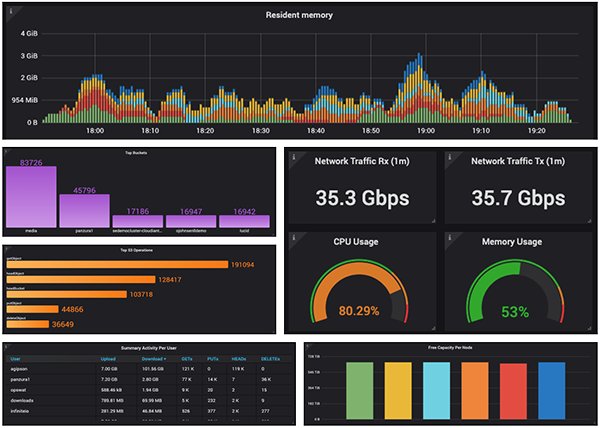

IBM watsonx is an AI and data platform designed to accelerate the adoption and deployment of AI across various business functions. It provides a unified environment for building, managing, and deploying AI models and applications, using generative AI. It enables the creation of custom AI solutions to support business operations.
Features:


Amdocs AI & Data Platform is a solution for collecting and monetizing data from any source, enabling organizations to scale efficiently. It produces business-ready data and uses embedded AI across the enterprise. This platform is modular and end-to-end, managing and automating operations and networks while striving to deliver superior customer experiences.
Features:


WEKA offers a data platform designed to accelerate the transition of enterprises to AI, aiming to combine cloud simplicity with on-premises performance. This AI native data platform can store, process, and manage data across various locations, ensuring speed, simplicity, scale, and sustainability. It caters to data-driven organizations with next-generation workloads like AI and High-Performance Computing (HPC).
Features:
The VAST Data Platform enables data-intensive computing by providing a software infrastructure for capturing, cataloging, refining, enriching, and preserving data through real-time deep data analysis and deep learning.
Features:

AI data platforms are pivotal in enabling organizations to harness the full potential of their data. By integrating robust data management capabilities with advanced AI and ML tools, these platforms facilitate efficient data processing and insightful analysis. This empowers businesses to make informed decisions, innovate, and stay competitive in the age of AI.
See Cloudian first in Google Search

