


Request a Demo
Join a 30 minute demo with a Cloudian expert.
AI storage solutions are specialized systems to manage the massive data volumes of AI/ML workloads by providing high performance, scalability, and AI-specific features such as RDMA for S3 and rich metadata support. They often incorporate technologies like high-speed NVMe flash storage and object storage to handle large datasets, support efficient training and inference, and ensure reliability and security.
Examples of AI storage solutions include Cloudian Hyperstore, VAST Data, and IBM AI Storage.
Key characteristics of AI storage solutions include:
This is part of a series of articles about AI infrastructure
In this article:
Traditional storage architectures are typically optimized for transactional workloads and general-purpose file access patterns, which differ significantly from the demands of AI workloads. AI training and inference require simultaneous access to large datasets, often consisting of high-volume, unstructured data like images or video. Conventional storage systems lack the needed throughput and direct-to-GPU data transfer features, and consequently struggle to deliver the throughput and parallelism necessary for efficient GPU utilization in these scenarios.
Standard storage solutions also introduce latency bottlenecks due to their reliance on hierarchical data access methods, which aren’t designed for the sequential and high-speed data pipelines needed in AI environments. File locking, metadata management overhead, and limited bandwidth further constrain performance during model training or large-scale data preprocessing.
As AI datasets grow into petabytes, traditional storage lacks the flexibility to scale linearly without performance degradation. These systems often can’t integrate tightly with parallel file systems or distributed storage frameworks essential for AI infrastructure. This results in underutilized compute resources and prolonged training times.
AI storage systems deliver high throughput and low latency, supporting the data-intensive operations typical of AI training and inference. They leverage NVMe, all-flash architectures, or other hardware to reduce bottlenecks, ensuring that GPU clusters or distributed compute engines never sit idle waiting for data.
Parallel data access is another performance-critical feature, with AI storage solutions supporting concurrent reads and writes from thousands of clients and processes directly to GPUs, bypassing CPU bottlenecks. The architecture must avoid single points of contention so that large-scale training can progress efficiently. AI storage systems often provide native support for distributed file systems and object storage protocols, which are optimized for streaming and random-access workloads.
Data volumes and computational demands grow rapidly as AI projects evolve. These systems are designed to expand from terabytes to multiple petabytes without hitting performance walls. Modern AI storage can dynamically add capacity and distribute workloads across nodes, all while delivering predictable, linear scaling in bandwidth and IOPS.
For organizations running multiple AI projects, the ability to scale out both storage and performance ensures that unpredictable or spiky workload patterns don’t cause service interruptions or force disruptive upgrades. AI storage solutions achieve this with flexible architectures like scale-out NAS, distributed object stores, and tiering across cloud and on-premises resources.
Data management is another core capability for AI storage systems. Managing billions of files or objects requires sophisticated metadata handling, versioning, and indexing so datasets can be accessed, labeled, and curated efficiently. AI storage platforms frequently include built-in lifecycle management tools that automate data movement, retention policies, and archiving based on defined criteria.
These systems must also address the challenge of data provenance and reproducibility, allowing organizations to trace model inputs and transformations across evolving datasets. Integration with data catalogs, tagging, and search functionalities allows AI teams to quickly locate and prepare data for different experiments.
AI workloads consume and produce an array of data types, from unstructured files (like images, videos, and audio) to structured tabular data and semi-structured text or logs. AI storage systems must efficiently handle this diversity without sacrificing access speed or data integrity. Their architectures make it possible to ingest, store, and serve both large single objects and millions of small files with the same reliability.
Just as importantly, these systems support a variety of data access protocols (e.g., POSIX, NFS, S3), allowing organizations to choose the optimal data formats and workflows for each use case. This broad compatibility lets AI teams ingest training data from disparate sources, integrate with existing analytics pipelines, and deliver high-performance reads and writes.
Data loss or extended downtime can compromise valuable AI model training or real-time inference. AI storage systems implement redundancy mechanisms, such as replication, erasure coding, and end-to-end checksumming, to maintain data integrity and durability even in the face of hardware or software failures. Recovery and failover must be transparent and rapid to minimize the impact of disruptions.
Security is equally critical, given the sensitive nature of many AI workloads and datasets. AI storage platforms offer fine-grained access controls, encryption at rest and in transit, and detailed auditing. They also integrate with enterprise identity management and compliance frameworks, supporting regulatory requirements such as GDPR and HIPAA.
AI storage systems must integrate easily with popular AI and machine learning frameworks, as well as existing infrastructure. Native support for deep learning toolkits, orchestration platforms (like Kubernetes), and cloud services accelerates deployment. Many AI storage platforms provide APIs and plugins that connect directly to PyTorch, TensorFlow, or other tools.
Integration isn’t limited to software, hardware compatibility matters as well. AI storage should work optimally with GPU clusters, CPU-based analytics, and hybrid deployments across on-premises and cloud. Unified management consoles and monitoring tools help bridge these environments, allowing organizations to centralize control, reduce operational overhead, and automate the flow of data between compute and storage layers.

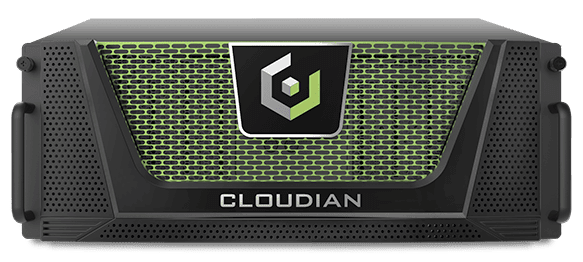
Cloudian HyperStore is a software-defined, S3-compatible object storage platform designed for on-premises and hybrid cloud deployments. HyperStore provides organizations with unlimited scalability and native S3 compatibility, enabling them to manage massive volumes of unstructured data while maintaining complete control over data location, security, and economics.
Key features include:
VAST Data is an AI-native storage platform to meet the performance, scale, and availability demands of modern AI workloads. It delivers a unified flash-based architecture that accelerates data access across the model lifecycle. Its design enables real-time inferencing, continuous training, and 24/7 availability.
Key features include:

IBM AI Storage is a unified data platform to support AI, machine learning, analytics, and high-performance computing. Designed to overcome challenges like distributed data, GPU underutilization, and workload silos, IBM’s AI storage solutions simplify access to enterprise data while maintaining high performance and low latency.
Key features include:


Huawei OceanStor AI Storage is a high-performance distributed file storage platform for AI training and inference. It addresses challenges such as inefficient GPU utilization, slow inference speeds, and hallucinations by unifying diverse data types and improving data access.
Key features include:


Pure Storage delivers a unified, high-performance platform for AI training, inference, and data preparation. Its architecture is intended to eliminate infrastructure bottlenecks by offering predictable throughput, simple management, and always-on availability across exabyte-scale environments.
Key features include:

Organizations should consider the following best practices when adopting an AI storage solution.
Selecting the right storage architecture begins with analyzing the unique requirements of different AI workloads, such as training, inference, and pre-processing. Workloads that demand high sequential throughput (like deep learning model training) benefit most from parallel file systems and all-flash arrays. Workloads dominated by random small file operations or mixed reads and writes may require scalable object stores with metadata management and indexing.
Matching storage architecture to workload ensures consistent performance and optimal resource utilization, helping organizations avoid costly overprovisioning or bottlenecking. Careful evaluation of protocols, compatibility with orchestration frameworks, and ease of integration with AI toolchains must be part of the selection process.
Designing AI storage systems for resilience means accounting for hardware failures, site outages, and software faults from the start. Effective architectures use redundancy through erasure coding, replication, and distributed nodes to isolate failure domains and prevent single points of failure. Key data and metadata should be distributed across multiple racks, zones, or data centers to achieve fault tolerance without sacrificing performance.
Multi-zone resilience is particularly important for mission-critical or regulated workloads. Architectures that span multiple cloud availability zones or on-premises clusters ensure that if one site or zone fails, data access and processing continue. Automated failover, disaster recovery planning, and regular testing are essential steps in validating resilience.
Lifecycle management is necessary to balance the growth of AI datasets with storage cost and performance considerations. AI storage systems should automate data movement, archiving, and deletion based on usage patterns, project stages, or compliance obligations. Automated tiering (from hot NVMe storage to cold object stores) ensures frequently accessed training datasets get top-tier performance, while older or less critical data is moved to archival.
Effective lifecycle management includes versioning, metadata tagging, and change tracking to support reproducibility and compliance. Storing raw, processed, and labeled data in clearly defined stages allows AI teams to retrain or audit models using historical input. Integrating lifecycle policies with AI pipelines creates a feedback loop that helps optimize storage usage.
Monitoring for performance bottlenecks is essential throughout an AI project’s lifecycle. Even the best storage systems can experience slowdowns caused by non-optimal configurations, uneven workload distribution, or underlying hardware defects. Continuous performance metrics, such as IOPS, latency, and data throughput, must be collected, visualized, and analyzed to identify real-time or trending issues during both training and inference.
AI storage solutions should support rich monitoring and alerting capabilities, with integration into existing observability stacks or AI workflow orchestrators. Proactive identification and remediation of slow storage nodes, overloaded network paths, or metadata server congestion will ensure predictably high performance.
AI projects are notorious for bursts of rapid growth in both data volume and compute utilization. Preparing storage for these unpredictable scaling demands requires flexible, elastic architectures that can quickly add capacity and bandwidth without downtime or disruption. Solutions that support auto-provisioning, hot expansion of nodes, and dynamic performance allocation are best suited to meet these challenges.
Anticipating spikes in workload may also involve hybrid deployments, with cloud storage for overflow or backup, and intelligent tiering to balance cost and performance as needs change . Organizations should regularly reassess usage patterns and capacity forecasts, ensuring that infrastructure, processes, and automation keep pace with evolving AI objectives.
AI workloads place exceptional demands on storage infrastructure, requiring systems that can deliver sustained performance, flexible scalability, and robust data management. Unlike general-purpose solutions, AI storage must support diverse data types, high throughput, and seamless integration with complex compute pipelines. To meet these demands, organizations need to design storage strategies that align with the entire AI lifecycle, from data ingestion and model training to deployment and long-term archiving, while maintaining reliability, security, and cost efficiency.
See Cloudian first in Google Search

