


Request a Demo
Join a 30 minute demo with a Cloudian expert.
Object storage manages and stores data as objects, rather than files in a hierarchical file system or blocks within sectors. Each object includes the data itself, metadata, and a unique identifier, making it suitable for handling unstructured data such as images, videos, backups, and large datasets. Unlike traditional storage, object storage is highly scalable, supports distributed environments, and provides efficient access to large volumes of information through HTTP-based APIs.
This design separates it from file and block storage both in architecture and use cases. Object storage platforms are valued for durability, flexibility, and compatibility with cloud-native applications. They allow for limitless storage growth, simplified data management, and accessibility from anywhere via standard protocols. Demand continues to climb: industry analyses value the global object storage market in the single-digit billions of dollars, with forecasts projecting sustained double-digit annual growth through the early 2030s as unstructured data volumes surge.
In this article:
As unstructured data volumes climb and AI adoption accelerates, object storage has moved from a back-office archive to a strategic foundation for modern data infrastructure. Newer platforms emphasize S3-compatible access, high-throughput performance for AI pipelines, and hybrid deployment across on-premises and cloud environments.
Editor’s note: Updated the article in 2026 to add recent market research and AI-driven storage trends and add a new section on object storage as the data layer for AI.
Organizations deploy object storage on-premises to meet specific regulatory, performance, and integration needs that public cloud storage may not fully address. Increasingly, these deployments are hybrid by design, keeping hot and sensitive data on-premises while tiering warm and cold data to S3-compatible cloud archives for cost efficiency.
Object storage systems are optimized for managing large volumes of unstructured data, making them suitable for a wide range of modern IT and business scenarios. The rapid expansion of AI workloads has accelerated this shift, as training and inference pipelines generate and consume unstructured data at petabyte and exabyte scale. Here are common use cases where object storage offers clear advantages:
IoT and sensor data storage: Ingesting and retaining time-series data from devices and sensors for analysis and real-time processing.
Object storage has become the default data layer for large-scale AI, because it decouples compute from storage and lets teams grow GPU clusters and capacity independently while sharing a single, S3-compatible repository. Its flat namespace and metadata model handle the mix of images, video, logs, model checkpoints, and training corpora that AI pipelines depend on, avoiding the metadata bottlenecks that stall traditional file systems.
A major recent advance is direct GPU-to-object data movement. Using RDMA over the standard S3 API, new integrations stream object data straight into GPU memory while bypassing the host CPU, preserving the universal S3 interface that AI tools already rely on. This keeps GPUs compute-bound rather than waiting on data, reducing CPU overhead in the data path and improving throughput for both training and inference at scale.
The practical takeaway is that object storage is no longer just a cost-effective archive tier. For AI-ready deployments, evaluate platforms on high-throughput parallel access, native S3 support, and emerging RDMA-accelerated data paths alongside traditional durability and scale.

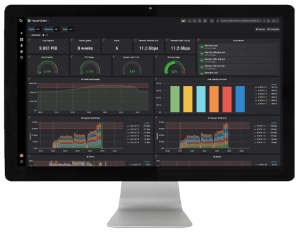
Cloudian HyperStore Object Storage Software is an enterprise-grade, software-defined storage platform designed for managing massive volumes of unstructured data at scale. Built for AI-ready performance and secure, hybrid-cloud integration, HyperStore empowers organizations to maintain full data sovereignty while delivering high throughput and bulletproof ransomware protection.
With seamless S3 API compatibility and unified file-object storage, it supports capacity-intensive workflows—like AI/ML, data analytics, and backup/archival—while offering flexible deployment options on commodity hardware or Cloudian appliances.
Key features include:
2. Ceph

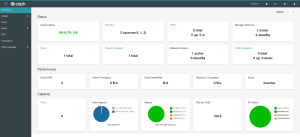
Ceph is a unified, open-source storage platform that provides object, block, and file storage in a distributed system. It is intended for high performance, scalability, and fault tolerance, making it suitable for cloud infrastructure and data-intensive workloads. Ceph uses the CRUSH algorithm to distribute across the cluster, ensuring performance without relying on traditional RAID.
Key features include:

Scality RING is a software-defined object storage solution built for petabyte-scale environments. It supports unstructured data workloads across a range of use cases including backup, media archives, and cloud-native applications. RING delivers high throughput and resiliency by distributing data across a scale-out cluster using erasure coding. Designed for hybrid and multi-cloud deployments, it integrates with public cloud services and supports S3 and NFS protocols.
Key features include:


Quantum ActiveScale is a scale-out object storage system for managing large unstructured datasets in on-prem and hybrid cloud environments. It targets data archiving, research, media, and analytics workflows by providing long-term durability, performance, and integration with S3-compatible applications.
Key features include:


Dell EMC Elastic Cloud Storage (ECS) is an object storage platform built for modern workloads, offering multi-protocol access, strong consistency, and geo-replication. ECS supports cloud-native applications, backup, and compliance archiving, and is available as software-defined or appliance-based deployments.
Key features include:

Selecting the right object storage solution depends on technical requirements, budget constraints, and workload types. Enterprise storage vendors are increasingly converging on S3 as the universal object API, so broad S3 compatibility has become a baseline requirement for interoperability across backup, analytics, and AI tools. Here are key factors to consider when evaluating object storage products:
Object storage delivers a scalable, durable, and flexible foundation for managing unstructured data across a wide variety of use cases. Its architectural advantages and compatibility with modern cloud environments make it a core component of modern data infrastructure, supporting growth, simplifying management, and enabling seamless access regardless of scale or location.
See Cloudian first in Google Search

