



Begasoft AG selected Cloudian HyperStore as the object storage foundation for an AI data lake supporting Brandbot and its broader data services portfolio. Here’s why.
Begasoft is a Bern-based information technology company that has been shaping Switzerland’s digital landscape for more than 25 years. The company delivers managed cloud infrastructure, IT operations and security, custom software development, and a growing portfolio of SaaS and AI services to organizations across the public sector, healthcare, financial services, and software industries.
Begasoft operates from a Tier-IV-certified data center in Bern Wankdorf, holds ISO 9001, ISO 14001, ISO 20000, ISO 27001, and ISAE 3000 (Type 2) certifications, and is FINMA-compliant. The company carries the “swiss hosting” label, guaranteeing that customer data remains within Swiss borders — a critical requirement for the federal agencies, cantonal governments, healthcare organizations, and regulated enterprises it serves.
Customers include federal offices such as BAKOM, BAFU, BASPO, ESTV, BAZL, and BAG, the Canton of Bern, Switzerland Tourism, Swiss-Ski, Reka, and Allianz. Begasoft is also the developer and technical operator of simap.ch, the official online platform for Swiss public-sector procurement.

The Opportunity: Sovereign AI for Swiss Organizations
As generative AI moved from experimentation to enterprise deployment, Begasoft saw a clear market gap. Swiss organizations — particularly those in government, healthcare, and finance — wanted to put their internal knowledge to work with AI assistants, chatbots, and retrieval-augmented generation (RAG) workflows. But they could not accept the trade-offs of public cloud AI services: data leaving Swiss jurisdiction, opaque model training, and limited control over how proprietary information is processed and stored.
Begasoft responded by building Brandbot, a Swiss AI orchestration platform that lets organizations deploy chatbots, virtual assistants, and AI-powered workflows on infrastructure that never leaves Switzerland. Brandbot supports flexible model choice across leading proprietary and open-source large language models, multi-channel deployment to web, WhatsApp, Microsoft Teams, Slack, and Confluence, and end-to-end RAG pipelines that ground AI responses in each customer’s own documents and knowledge.
Brandbot has gained traction with organizations such as SuisseOffer, the Swiss Football League, BernerKMU, and Previon Plus AG, and is now expanding into larger enterprise deployments. Underpinning all of it is a foundational architectural question: where does the data live?

The Challenge: A Storage Foundation Built for AI and Regulated Workloads
To deliver Brandbot at scale, Begasoft needed a storage layer that could serve as both the document repository for RAG knowledge bases and the data lake supporting the broader AI pipeline. The requirements were demanding:
- Native S3 API: Modern AI tooling — vector database ingestion frameworks, document parsers, embedding pipelines, MLOps platforms — assumes an S3 interface. Anything less than full S3-native behavior creates integration friction.
- Swiss data residency: Customer documents, conversation histories, and embeddings all needed to remain in Switzerland to satisfy revDSG, GDPR, and sector-specific regulations such as FINMA.
- Multi-tenant isolation: As a service provider hosting many customers on shared infrastructure, Begasoft required strict per-tenant data separation, including isolation from Begasoft itself.
- Scalability without re-platforming: The same architecture had to support a single-tenant PoC of a few terabytes and an enterprise deployment of many times that, without disruptive migrations.
- Cost-effective economics: Service provider margins depend on storage that scales efficiently — both in capital cost per terabyte and in operational overhead.
- Workload versatility: Beyond AI, Begasoft also runs Apache NiFi data integration pipelines that handle large volumes of structured and semi-structured data for customer use cases. A single storage platform for both AI and data integration workloads was strongly preferred.
The Solution: Cloudian HyperStore as the AI Data Lake
Begasoft selected Cloudian HyperStore as the object storage foundation for Brandbot and its broader data services portfolio. HyperStore is deployed in Begasoft’s Tier-IV Swiss data center and serves as the single S3-native repository for both the AI/RAG architecture and the company’s Apache NiFi workloads.
Role in the Brandbot RAG Architecture
Within Brandbot, Cloudian HyperStore sits at the center of the data lake as the persistent home for unstructured content. It plays two distinct roles in the RAG pipeline:
- Document and knowledge base repository: Customer documents — policies, manuals, contracts, knowledge articles, regulatory texts, and other source material — are stored in HyperStore. When a Brandbot assistant cites a source or links to an underlying document in a chat response, that document is served directly from HyperStore.
- Source for the vectorization pipeline: Documents in HyperStore feed Brandbot’s vectorization pipeline, where they are chunked, embedded by Swiss-hosted embedding models, and indexed into a vector database. The original objects remain in HyperStore as the durable system of record, available for re-ingestion as embedding models evolve or chunking strategies change.
This architecture lets Brandbot decouple the durable knowledge layer from the vector index. Documents can be added, updated, or removed in HyperStore, and the vector database is refreshed from that source of truth — without losing the original content or its lineage.
Why Cloudian
- S3-native interface: HyperStore exposes the full S3 API, so Brandbot’s ingestion, retrieval, and vectorization components integrate with HyperStore the same way they would integrate with any S3 data lake — no custom adapters, no compatibility gaps.
- Swiss data sovereignty by design: Because HyperStore runs in Begasoft’s own Swiss data center, customer data, embeddings, and chat-referenced documents stay within Swiss jurisdiction throughout their lifecycle.
- Multi-tenancy for service providers: HyperStore’s encryption, QoS, and reporting, with strict isolation between tenants — and between tenants and the service provider. This matches Brandbot’s workspace and project model directly.
- Government-verified security: HyperStore’s security capabilities — including S3 Object Lock for immutability, AES-256 encryption with KMIP, and certifications across Common Criteria, FIPS 140-3, and related standards — give Begasoft and its customers a defensible security posture for regulated workloads.
- Linear scalability: HyperStore scales out by adding nodes, with no architectural ceiling. Begasoft can size each customer environment to current needs and grow without re-platforming as adoption increases.
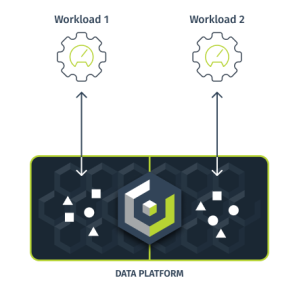
- Workload consolidation: The same HyperStore platform serves Begasoft’s Apache NiFi data integration workloads alongside the Brandbot AI use cases, simplifying operations and reducing the number of storage platforms Begasoft has to manage.
Results: From PoC to Production-Scale AI Data Lake
With Cloudian HyperStore in place as the AI data lake, Begasoft has been able to move Brandbot from concept to commercial reality across a growing customer base:
- Multiple Brandbot proof-of-concept engagements are running on the HyperStore foundation, each with a dedicated, isolated environment.
- A major enterprise client implementation is now beginning — moving Brandbot beyond pilots into a full-scale production deployment with significant data volumes.
- Begasoft operates a single S3-native storage platform that serves both AI/RAG workloads and Apache NiFi data integration — reducing operational complexity and enabling consistent governance across very different use cases.
- Customer data, embeddings, and conversation context remain entirely within Switzerland, giving Begasoft a defensible answer to the data sovereignty questions that come with every Swiss enterprise and public-sector AI conversation.
- As new Brandbot customers come on board, Begasoft can provision new tenants on the existing HyperStore platform rather than standing up new infrastructure — supporting a scalable service-provider business model.
“Brandbot’s value to our customers depends on keeping their documents, embeddings, and conversation context fully under Swiss data sovereignty while still integrating with the best AI tooling on the market. Cloudian HyperStore gives us a native S3 data lake that drops directly into our RAG architecture. Documents flow into the vectorization pipeline without custom adapters, and everything stays in our Swiss data center. It’s the foundation that lets us scale Brandbot from proof-of-concept to enterprise deployments without rethinking the data layer.”
Looking Ahead
Begasoft and Cloudian continue to deepen the integration between Brandbot and HyperStore as enterprise AI adoption accelerates across the Swiss market. With a sovereign, scalable, and S3-native AI data lake foundation in place, Begasoft is positioned to onboard new Brandbot customers quickly — from internal company chatbots and process assistants to citizen-facing applications for the public sector — while keeping every byte of customer data on Swiss soil.
About Begasoft
Begasoft AG is a Bern-based Swiss IT company providing managed cloud infrastructure, IT operations and security, custom software development, and AI services. Operating from a Tier-IV Swiss data center and certified to ISO 27001 and ISAE 3000, Begasoft has served Swiss federal and cantonal government, healthcare, financial services, and enterprise customers for more than 25 years. Learn more at www.begasoft.ch.
Learn more at Cloudian.com.


