


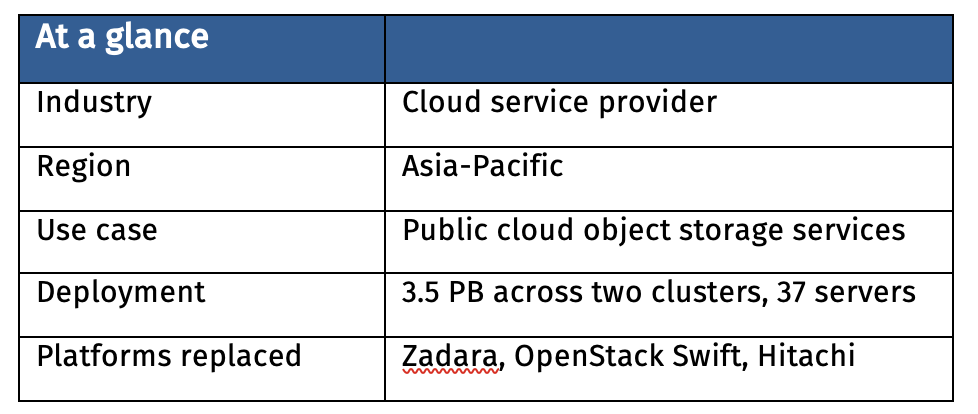
The customer is one of the largest cloud service providers in the Asia-Pacific region, with annual recurring revenue exceeding $500 million. It operates a full public cloud platform serving enterprise and public sector customers, including compute, networking, and storage services delivered from multiple domestic data centers. Having built its business as a traditional cloud service provider, the company has since evolved into a neocloud, extending its platform to host AI infrastructure and services for customers building and running AI applications. Object storage is a core revenue-generating service in its catalog, and the company competes directly with global hyperscalers in its home market on the strength of local presence, data sovereignty, and regulatory compliance.
The customer
The provider is one of the largest cloud service providers in Asia-Pacific, with annual recurring revenue above $500 million. It runs a full public cloud platform for enterprise and public sector customers, delivering compute, networking, and storage from multiple domestic data centers.
Object storage is a core revenue-generating service in its catalog. The company competes directly with global hyperscalers in its home market, winning on local presence, data sovereignty, and regulatory compliance.
The challenge: three storage platforms, none built for a multi-tenant service
Over several years, the provider had built its object storage services on a mix of platforms: Zadara, OpenStack Swift, and Hitachi. None proved to be a durable foundation for a commercial multi-tenant service.
S3 compatibility gaps turned onboarding into integration work
The provider’s end customers build applications against the AWS S3 API, and they expected the same behavior from a domestic cloud. The incumbent platforms supported only a subset of that API. As a result, applications that worked on AWS needed rework before they could run on the provider’s service.
Every new customer onboarding became an integration project. Engineering time went into closing compatibility gaps instead of building new capabilities, and implementation costs grew with each deployment.
Billing and security limited what the provider could sell
Two further constraints held the business back:
- Manual billing data. Tenant-level usage data had to be assembled through manual and semi-automated processes, not pulled directly from the storage platform. This slowed the launch of usage-based pricing.
- Public sector requirements. Public sector deals required security certification and integration with enterprise key management. The incumbent platforms could not meet either requirement.
Left unaddressed, these problems meant a service the provider could not differentiate, a cost structure it could not improve, and a public sector market it could not enter.
The evaluation: a seven-month process with a formal PoC
The provider ran a structured evaluation from July 2023 through January 2024, including a formal proof of concept (PoC) from August to October 2023. A regional reseller partner introduced Cloudian, and the provider assessed it alongside several alternatives. One other software-defined object storage vendor emerged as the principal competitor.
Two factors separated Cloudian in the PoC:
- KMIP integration, proven during the PoC: The provider’s security architecture required KMIP integration with an external enterprise key manager. Working with the customer and the key management vendor, Cloudian’s engineering team completed a full KMIP functional test against the customer’s chosen KMIP server during the PoC. The competing platform could not demonstrate equivalent functionality within the evaluation.
- Software-only economics: Cloudian HyperStore runs on standard x86 servers that the customer selects. That meant the provider kept control of its hardware sourcing and vendor relationships, instead of paying an appliance vendor’s hardware margin. This flexibility translated directly into a lower cost per terabyte for the service.
The solution: 3.5 PB of HyperStore serving about 219 tenants
The provider now runs Cloudian HyperStore across two production clusters totaling 3.5 petabytes on 37 servers. Roughly 219 tenants are active across the two clusters, and the deployment required no professional services engagement.
The capabilities that drove the selection are the ones the provider uses in production every day:
- S3 API compatibility deep enough that end customer applications written for AWS run without modification
- Multi-tenancy with QoS controls and an integrated billing system that exposes per-tenant usage data through an API
- Multi-data-center support with bucket-level tiering policies and cross-region replication
- Object Lock for immutable retention
- KMIP integration with the customer’s external key management infrastructure
The results
Standardizing on HyperStore changed how the provider onboards customers, prices its service, and reaches new markets.
- S3 compatibility without custom integration: End customers now get behavior consistent with AWS S3. That removed the per-customer integration effort that defined onboarding on the previous platforms.
- Lower implementation cost per deployment: Software-only licensing on customer-selected commodity hardware reduced the cost of standing up new capacity. That improved the margin profile of the service.
- Simpler billing data collection: Usage and metering data now comes from the platform’s API instead of being assembled by hand. This shortened the path to launching usage-based service tiers.
- Access to the public sector market: Demonstrated KMIP integration opened a customer segment the previous platforms could not serve.
What comes next: nationwide public sector expansion and AI storage
The provider is planning a nationwide expansion of the service for public sector customers, deployed in an active-active disaster recovery configuration across multiple regions.
Cloudian also has a defined role in the provider’s AI storage architecture. HyperStore serves as the second tier beneath high-performance parallel file systems, providing the capacity layer for fast-growing training and inference datasets. As demand for inference services grows, the provider is evaluating Cloudian as a dedicated storage solution for inference workloads.
Build your cloud storage service on Cloudian
Cloud and service providers use Cloudian HyperStore to deliver S3-compatible object storage with multi-tenancy, integrated billing, and the enterprise key management integration regulated customers require. Contact Cloudian to learn how HyperStore can support your storage services.


