


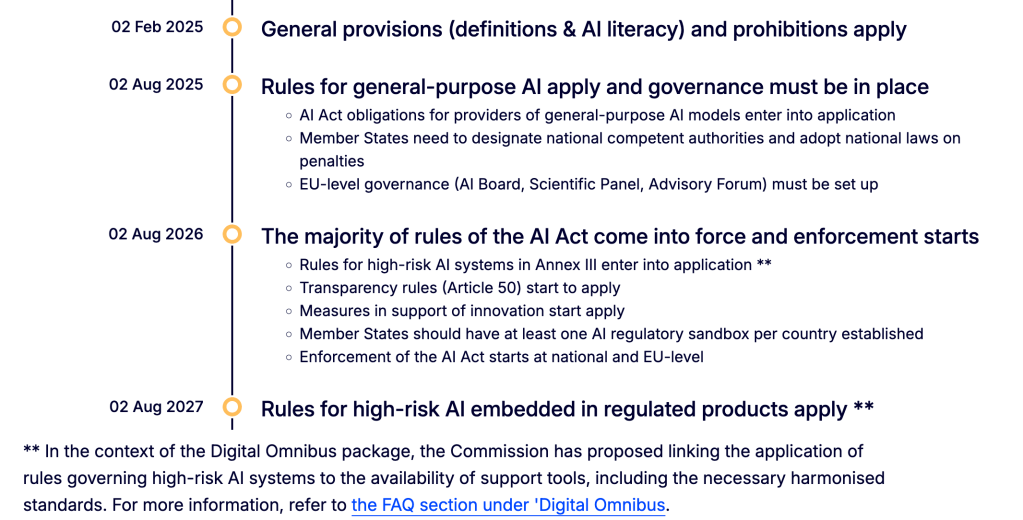
For the EU AI Act, August 2, 2026 is not a distant policy horizon. It is the moment compliance obligations become real.
On that date, a significant set of EU AI Act requirements take effect for the organizations most directly involved in building and deploying AI systems. Providers, importers, distributors, deployers, and others will be required to comply with the full set of obligations the Act imposes for high-risk systems.
At the same time, providers and deployers of certain limited-risk AI systems face new transparency requirements. If your organization operates AI chatbots that interact directly with humans, or AI systems capable of generating synthetic content, you will be required to meet disclosure and documentation obligations by the same date.
The practical implication is straightforward: for many organizations, the compliance window is not months away — it is already open.
Here is the implementation timeline, as published by the European Commission:
What the EU AI Act Requires
The EU AI Act is the world’s first comprehensive legal framework governing AI development and deployment. Built on a risk-tiered classification system, it assigns obligations to AI systems based on their potential for harm.
The highest scrutiny is reserved for high-risk applications. For these, the Act’s requirements are substantive. Organizations must demonstrate that AI training, validation, and testing data meets defined standards for quality, representativeness, and freedom from harmful bias. They must maintain detailed technical documentation covering how the system was built, what data was used, and how it was tested. They must retain operational logs in a format accessible to regulators. And they must implement human oversight mechanisms capable of intervening in AI-driven decisions.
None of these requirements can be satisfied at the model or application layer alone. They must be built into the data infrastructure that AI systems run on.
Why Data Management Is the Core Compliance Challenge
Much of the early EU AI Act commentary focused on algorithmic accountability and model governance. But the Act’s most immediate operational impact lands on data management, specifically on the infrastructure that stores, protects, and governs the data AI systems consume.
Meeting the Act’s requirements demands capabilities that many organizations’ current infrastructure cannot provide:
- Data residency controls. When high-risk AI systems process personal data, organizations must be able to demonstrate that data has not crossed jurisdictional boundaries in ways that violate GDPR or applicable national law. Public cloud storage makes this difficult to guarantee. On-premises or sovereign infrastructure makes it verifiable.
- Immutability and audit trails. AI training datasets must be preserved in tamper-evident form for regulatory review. That means write-once storage protections, immutable access logging, and the ability to reconstruct the exact dataset used in any given training run at any future point in time.
- Granular lifecycle management. The intersection of the AI Act and the GDPR creates a thorny operational problem: data subjects have the right to erasure and rectification, but AI models benefit from large, stable datasets. IT managers need object-level lifecycle management — the ability to identify, isolate, and delete specific individuals’ records within a training dataset without disrupting the broader dataset or the models trained on it.
- Access governance. Organizations must be able to document exactly which teams had access to which datasets, under what policy, and during what time period. Multi-tenancy architecture with per-project role-based access controls is not a nice-to-have; for compliance purposes, it is the evidentiary record.
What IT Managers Should Do Now
The organizations best positioned for August 2026 are the ones that treat compliance as an infrastructure project, not a paperwork exercise. That means taking several concrete steps:
Start by auditing your AI system inventory against the Annex III categories. If you are building, deploying, or integrating AI systems used for biometric identification, HR and hiring decisions, educational assessment, or worker management, you are almost certainly in scope. Document what data those systems consume, where that data lives, and whether your current storage infrastructure can support the audit trail and residency requirements the Act demands.
Evaluate your storage architecture for compliance readiness. Key questions include: Can you enforce data residency at the country or data-center level? Does your storage platform support immutable retention with tamper-evident logging? Can you execute object-level deletions against individual data subjects within large unstructured datasets? If the answers are uncertain, the time to address them is before the deadline, not after.
Engage legal and compliance stakeholders early. The AI Act’s conformity assessment process requires a technical file that documents your data governance practices in detail. That documentation is substantially easier to produce if your infrastructure has been designed to support it from the beginning.
How Cloudian HyperStore Provides the Compliance Foundation
Cloudian HyperStore is S3-native object storage built for on-premises deployment — which means AI training data stays within a defined geographic and jurisdictional boundary by architectural design, not contractual promise. For organizations subject to EU AI Act data residency requirements, this distinction matters enormously.
HyperStore’s S3 Object Lock implements WORM (Write Once, Read Many) protection at the object level, preventing modification or deletion of AI training datasets during defined retention periods. Immutable access logging creates the tamper-evident audit trail regulators will expect to see. Legal hold capabilities allow datasets to be preserved beyond standard retention periods when regulatory review is anticipated.
On the security side, HyperStore is certified to FIPS 140-3, FINRA, CFTC, and NIST 800-88 standards. Data is encrypted at rest with AES-256 and protected in transit with TLS 1.2/1.3. Per-tenant role-based access controls and administrative isolation ensure that access governance is enforced at the infrastructure level, not just policy.
For data lineage, HyperStore’s rich metadata capabilities allow organizations to tag every object in an AI pipeline with attributes — data origin, processing stage, regulatory classification, associated AI project — all stored within the same sovereign environment as the data itself. Integration with NVIDIA AI Data Platform, MLflow, and Kubeflow enables automated dataset versioning as part of model development workflows, making point-in-time reconstruction of any training dataset a straightforward operational task rather than a forensic exercise.
And for the right-to-erasure challenge, HyperStore’s object-level lifecycle management enables targeted deletion of individual data subjects’ records within large datasets, with audit-ready reporting on every lifecycle action.
The Window Is Open
The EU AI Act is not a 2027 problem. For organizations deploying high-risk AI systems this year, it is a 2026 problem — and the compliance infrastructure needs to be in place before the systems go live, not after the regulator asks for documentation.
The data management requirements the Act imposes are substantial, but they are solvable with the right infrastructure. Organizations that build sovereign, auditable, and policy-enforced data storage into their AI architecture now will meet the August 2026 deadline with confidence — and be well positioned as the Act’s remaining provisions take full effect in 2027.
Learn more at cloudian.com.


