


Request a Demo
Join a 30 minute demo with a Cloudian expert.
Object storage solutions store and manage large volumes of unstructured data. Unlike traditional file or block storage, object storage organizes data as discrete units called objects, each containing the data itself, associated metadata, and a unique identifier. This architecture allows for massive scalability, making it suitable for situations where data volumes can rapidly grow, such as cloud storage, backup and recovery, and big data analytics.
These solutions eliminate the hierarchical structure found in file systems. Instead, they use a flat namespace, which simplifies management and retrieval for large datasets. Object storage is accessed through standard APIs, such as S3, and is typically designed to ensure high durability and availability through mechanisms like replication and erasure coding.
Editor’s note: Updated the article to include recent object storage market trends, and updated information for object storage solutions to reflect features and capabilities in 2026.
In this article:
The global object-based storage market is expanding steadily as organizations manage rapidly growing volumes of unstructured data. The market is valued at USD 1.67 billion and is projected to reach USD 2.74 billion by 2030, reflecting a 10.41% compound annual growth rate (CAGR).
Several technological and operational factors are accelerating the adoption of object storage platforms.
Hybrid and multi-cloud architectures are becoming central to enterprise storage strategies. By 2024, approximately 78% of organizations operate multi-cloud environments, and object storage often serves as the common storage layer across them.
S3-compatible APIs allow workloads to move between public cloud platforms and on-premise clusters without major application changes. This capability helps organizations meet data sovereignty requirements while still using cloud resources for burst capacity or analytics workloads.
Automated tiering further supports hybrid strategies. Policies can move inactive data to lower-cost cloud tiers while keeping frequently accessed data on local infrastructure. This approach helps control storage costs while maintaining performance for active datasets.
Understanding the core components of object storage helps clarify how these systems manage and scale unstructured data. Here are the key elements that enable object storage to deliver performance, durability, and ease of access across a wide range of use cases.

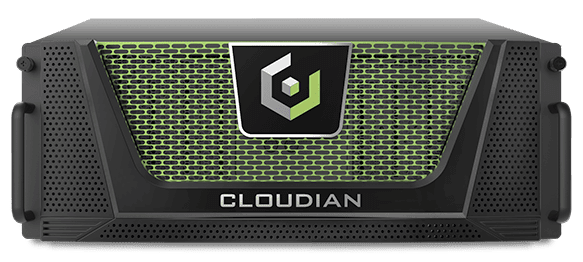
Cloudian HyperStore Object Storage Software is an enterprise-grade, software-defined storage platform designed for managing massive volumes of unstructured data at scale. Built for AI-ready performance and secure, hybrid-cloud integration, HyperStore empowers organizations to maintain full data sovereignty while delivering high throughput and bulletproof ransomware protection. With seamless S3 API compatibility and unified file-object storage, it supports capacity-intensive workflows—like AI/ML, data analytics, and backup/archival—while offering flexible deployment options on commodity hardware or Cloudian appliances.
Key features include:

Nutanix Objects Storage is a software-defined, S3-compatible object storage service that runs on the Nutanix AOS platform. It provides a scalable storage tier for unstructured data such as backups, archives, big data workloads, and cloud-native applications. The system can be deployed on existing Nutanix clusters, dedicated clusters for performance-intensive workloads, or across multiple clusters
Key features include:


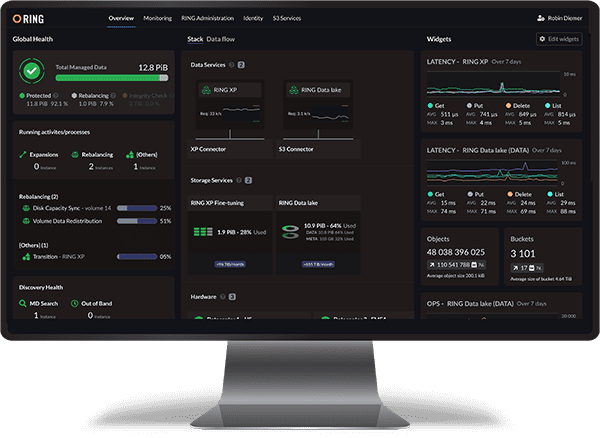
Scality RING is a software-defined object storage platform for large-scale, distributed environments that manage massive volumes of unstructured data. It supports cloud and hybrid deployments and is built to handle unpredictable workloads across many applications. The platform uses a scale-out architecture that allows organizations to expand capacity, performance, and the number of supported workloads independently.
Key features include:

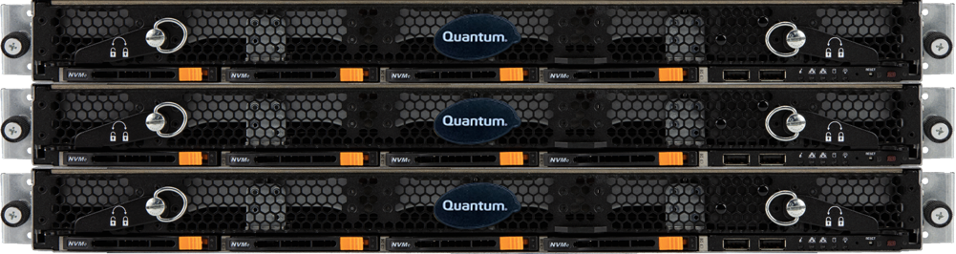
Quantum ActiveScale is a scalable object storage platform to manage both frequently accessed (“active”) data and long-term archive data in a single environment. It provides S3-compatible storage for workloads such as analytics, AI pipelines, backup repositories, and media processing. The platform integrates high-performance object storage with an optional cold storage tier that is compatible with S3 Glacier-style archival storage.
Key features include:
Dell ObjectScale is an enterprise object storage platform for large-scale data environments and modern workloads such as AI model training, analytics, and global data archives. The platform provides S3-compatible storage with an architecture designed to scale across distributed infrastructure. It can be deployed on existing or new infrastructure and integrates with containerized environments and modern application platforms.
Key features include:

Organizations should consider these practices to ensure an effective object storage strategy.
Effective object storage begins with a plan for the entire data lifecycle, from ingestion through retention, retrieval, and eventual deletion. Organizations should define clear policies for data classification, retention schedules, archival, and compliance. These policies control storage costs and ensure that aging or obsolete data does not clutter the environment, improving search and retrieval efficiency.
Mapping out the data lifecycle also involves anticipating organizational changes—such as regulatory adjustments or business expansion—that could impact storage requirements. Regularly reviewing and updating lifecycle policies ensures that the storage environment remains aligned with business objectives, legal obligations, and evolving data privacy regulations.
Automation is essential for maintaining efficient, large-scale object storage environments. Automated workflows can handle repetitive tasks such as policy enforcement, replication, tiering, and object deletions according to predefined rules. This reduces human error, simplifies management, and frees up IT teams to focus on strategic initiatives rather than manual operations.
Orchestration tools further enable integration with broader IT systems and processes. By linking object storage to data pipelines, backup systems, and cloud services, orchestration ensures that storage responds dynamically to changes in workloads and business needs. Using API-driven automation and orchestration also supports rapid scaling and recovery.
Monitoring is a non-negotiable element of object storage management. Real-time, granular monitoring allows organizations to track storage usage, latency, API calls, capacity trends, and system health. Modern object storage platforms offer built-in dashboards and the ability to integrate with third-party observability tools, providing visibility into both day-to-day operations and long-term trends.
Alerting complements monitoring by notifying administrators of issues like hardware failures, replication lag, or unauthorized access. Effective alerting systems enable rapid response and remediation, helping maintain data availability and compliance with service-level agreements. Customizable thresholds and escalation mechanisms ensure that critical incidents are prioritized.
Metadata is crucial for the function and performance of object storage, as it governs how data is indexed, searched, and retrieved. Ensuring metadata consistency is essential for maintaining data integrity across distributed environments. Organizations should establish strict protocols for metadata management, including regular audits, validation routines, and synchronization processes between storage nodes.
Consistent metadata guarantees reliable search, access control, and policy enforcement. Inconsistent or corrupted metadata can lead to data inaccessibility, security risks, or operational failures. Using automated tools for metadata health checks and correction can mitigate these risks, improve auditability, and support efficient data governance at scale.
Organizations should schedule routine reviews of their object storage security policies to account for evolving threats, compliance standards, and operational changes. These reviews should cover access controls, encryption settings, user permissions, and integration with identity management systems, ensuring that security is not compromised as environments change.
Updating and testing security measures regularly helps identify vulnerabilities, enforce least-privilege access models, and ensure effective response mechanisms exist for breaches or incidents. Documentation and audit trails should be maintained to track policy changes and demonstrate compliance. Security reviews should be a formal, recurring process.
Implementing object storage enables organizations to efficiently manage and protect rapidly growing unstructured data. By leveraging the inherent scalability, durability, and API-driven access of object storage solutions, teams can optimize data workflows and ensure long-term value from their information assets. A thoughtful approach to architecture, automation, monitoring, metadata management, and security creates a resilient storage environment.
See Cloudian first in Google Search

