


Request a Demo
Join a 30 minute demo with a Cloudian expert.
Enterprise storage solutions are systems for managing, storing, and protecting large volumes of business data, focusing on high performance, scalability, and reliability. These solutions can be on-premises, cloud-based (public, private, or hybrid), and often use technologies like NAS (Network Attached Storage), SAN (Storage Area Network), and object storage.
Such systems form the backbone of IT infrastructure in sectors ranging from finance to healthcare, where data accessibility and integrity are non-negotiable. Enterprise storage solutions often integrate features for automated backups, replication, disaster recovery, and security controls to meet regulatory requirements and operational needs.
As data requirements grow, these platforms enable organizations to expand their capacity and features without disrupting operations.
This is part of a series of articles about data backup
In this article:
Implementing enterprise storage solutions offers significant advantages for organizations that handle large-scale, business-critical data. These benefits go beyond basic storage, supporting better performance, data protection, and long-term scalability.

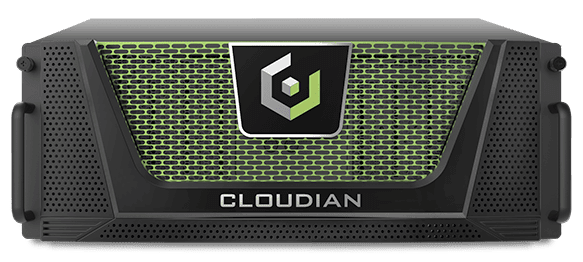
Cloudian HyperStore object storage software is an enterprise-grade, software-defined storage platform for managing massive volumes of unstructured data at scale. Built for AI-ready performance and secure, hybrid-cloud integration, HyperStore empowers organizations to maintain full on-prem data sovereignty while delivering high throughput and ransomware protection.
With native S3 API compatibility and unified file-object storage, it supports capacity-intensive workflows like AI/ML, data analytics, and backup/archival while offering flexible deployment options on commodity hardware or Cloudian appliances.
Key features include:

The NetApp AFF A-Series is a high-performance all-flash enterprise storage solution thats supports mission-critical workloads including databases, virtual environments, and AI applications. With capabilities like sub-millisecond latency, exabyte-scale capacity, and AI-powered data protection, it enables organizations to accelerate data access.
Key features include:


Dell ObjectScale is an enterprise object storage platform for large-scale data collection, AI model training, and long-term data retention. It supports petabyte- to exabyte-scale environments with consistent performance and global namespace management. ObjectScale can be deployed as software on existing infrastructure or on dedicated systems.
Key features include:

IBM FlashSystem is a family of high-performance flash and hybrid flash storage platforms to simplify data management, increase cyber resilience, and reduce operational costs through AI-driven automation. Built with a grid-based architecture and FlashCore Module technology, FlashSystem supports scalability, non-disruptive data movement, and workload optimization.
Key features include:


Huawei OceanStor is an enterprise storage platform to support the rapidly evolving demands of the digital economy, where data is a critical production asset. It enables organizations to build a data-centric infrastructure capable of handling diverse workloads, from transactional systems to unstructured data.
Key features include:

Effective scalability is essential for any enterprise storage solution. Organizations must plan for current and future data growth, evaluating how easily the system can add capacity without causing disruptions or incurring prohibitive costs. Solutions that offer scale-out architectures allow for gradual expansion by adding nodes or drives, rather than complete system overhauls.
Capacity planning should also account for the efficiency features built into storage products, such as deduplication, compression, and thin provisioning. These features maximize the usable storage from existing hardware, delaying the need for additional investments.
Performance is a critical factor in the evaluation of enterprise storage platforms, especially for businesses running databases, virtual environments, or applications requiring high-throughput data access. Storage solutions should incorporate technologies such as all-flash media, NVMe interfaces, and high-bandwidth interconnects to minimize latency and maximize throughput.
Latency bottlenecks can arise from network infrastructure, system architecture, or software protocols. Advanced solutions address these with parallel processing, quality of service (QoS) controls, and intelligent data path selection. Enterprises should also consider performance management tools, which provide ongoing visibility into latency metrics and enable rapid troubleshooting.
Enterprise storage must deliver consistent uptime and resiliency to avoid data loss or business interruption. Key features to consider include redundant controllers, power supplies, and network paths, which ensure that hardware failures do not result in downtime. Storage platforms should support technologies like RAID, erasure coding, and automatic failover.
Continuous data availability requires rapid, reliable recovery capabilities such as snapshots and synchronous replication. Organizations should assess vendors’ track records for system reliability and look for offerings with built-in monitoring and predictive maintenance powered by AI or analytics. These tools help identify issues before they result in outages.
Security is a non-negotiable requirement for enterprise storage. Solutions should provide native data encryption both at rest and in transit, integrated access controls, and audit trails for every data interaction. Features like role-based access control (RBAC) and multi-factor authentication are critical for preventing unauthorized access and demonstrating compliance with industry regulations such as GDPR, HIPAA, or PCI DSS.
Data governance capabilities, including automated data classification, retention, and policy enforcement, ensure sensitive data is handled appropriately throughout its lifecycle. Enterprises must also verify that potential storage solutions support integration with enterprise identity systems and third-party security tools.
A comprehensive disaster recovery plan is essential for maintaining business operations during hardware failures, cyberattacks, or natural disasters. Enterprise storage platforms should support disaster recovery techniques, such as point-in-time snapshots, replication to geographically distant sites, and integration with backup and archiving solutions.
Business continuity planning includes automated failover and failback processes, which reduce manual intervention and downtime. Storage solutions with support for multi-site clustering and cloud-based recovery open up additional options for meeting stringent recovery time objectives (RTOs) and recovery point objectives (RPOs).
Enterprise storage solutions are foundational to supporting modern business operations, offering the performance, scalability, and resilience needed for data-intensive environments. They provide centralized control, robust security, and flexible deployment options across on-premises, hybrid, and cloud infrastructures. By addressing critical needs such as data availability, compliance, disaster recovery, and workload optimization, these systems enable organizations to manage growing data volumes efficiently while maintaining operational continuity and strategic agility in an evolving digital landscape.
See Cloudian first in Google Search

