


Request a Demo
Join a 30 minute demo with a Cloudian expert.
TL;DR: Durable, resilient storage keeps data intact, self-healing, and available through failures. Top picks: Cloudian HyperStore for on-prem and hybrid object storage, Scality RING for multi-site scale, Amazon S3 for AWS-native durability, and MinIO for AI workloads.
Evaluating storage solutions requires balancing three distinct pillars: Durability (data loss prevention), Resilience (self-healing and disaster recovery), and Uptime (service availability). A highly available system can still lose data if it lacks durability, while a durable system may have poor uptime if it cannot handle network failures.
Different storage solutions are designed for different workloads. High-performance applications often require low-latency block storage, while file storage is better suited for shared documents and collaboration. Object storage is commonly used for backups, archives, media files, and cloud-native applications because it can scale to billions of objects while keeping management relatively simple.
Key evaluation criteria
Use these five criteria to compare the solutions in this guide:
Solutions compared in this guide
This is part of a series of articles about data backup
In this article:
Durability, resilience, and uptime measure different aspects of storage reliability. Durability refers to the likelihood that data remains intact over time, even if hardware fails. Resilience is the ability of the storage system to continue operating during failures by using techniques such as replication, erasure coding, snapshots, and failover. Uptime measures how consistently the storage service is available to users and applications.
These characteristics directly affect business continuity. A durable system protects against permanent data loss, a resilient system minimizes the impact of component failures, and high uptime reduces service interruptions. Together, they help organizations meet recovery objectives, maintain application availability, and avoid the operational and financial costs associated with downtime or lost data.
The right storage solution depends on how much each of the criteria below matters to your workloads. Work through them in order and check each candidate against the concrete questions.
Durability is the probability that stored data stays intact and recoverable over time, even as hardware components fail. It is usually expressed as a number of “nines,” representing how unlikely permanent data loss is over a year. Storage solutions achieve durability mainly through replication, which keeps multiple copies, and erasure coding, which splits data into fragments with parity so objects can be rebuilt from a subset. When comparing solutions, look at how durability is calculated, whether the protection scheme is configurable, and how much capacity overhead each approach adds.
Evaluation criteria:
Resilience is the ability of a storage system to keep operating and recover automatically when components fail. Where durability asks whether data survives, resilience asks whether the system keeps serving that data during drive, node, rack, or site failures. Techniques include self-healing, failover, and geographic distribution across sites or regions. When comparing solutions, examine which failure domains they protect against and whether recovery is automatic or needs manual intervention.
Evaluation criteria:
Availability measures how consistently the storage service can respond to read and write requests. It is usually stated as an uptime percentage, such as 99.9% or 99.99%, which translates directly into allowed downtime per year. A system can be durable yet still be unavailable if a network or controller failure blocks access. When comparing solutions, look at the availability level offered, whether it is backed by an SLA, and whether access continues during upgrades and expansions.
Evaluation criteria:
Related content: Read our guide to data availability
Storage needs rarely stay fixed, so the way a solution scales and where it can run matter as much as its protection features. Scale-out designs add capacity and performance by adding nodes, while deployment flexibility covers whether the solution runs on-premises, in the cloud, or across a hybrid of both. When comparing solutions, look at how growth is handled, the hardware it runs on, and how well it fits your current and future environments.
Evaluation criteria:
Protecting data from deletion, tampering, and ransomware has become a core storage requirement rather than an add-on. Immutability features such as Object Lock and write once, read many (WORM) prevent data from being changed or deleted for a set period, while encryption and access controls limit who can reach it. When comparing solutions, look at the immutability model, encryption options, and identity controls, plus any additional cyber-resilience layers.
Evaluation criteria:
Related content: Read our guide to immutable storage
The table below summarizes how each solution measures up against the key criteria. Each one is explored in detail in the sections that follow.
| Category | Solution | How It Meets the Criteria |
| Software-defined and on-premises object storage | Cloudian HyperStore | Per-bucket erasure coding and replication with drive-to-site protection, a peer-to-peer design with no single point of failure, and Object Lock, giving strong durability, resilience, and immutability for on-prem and hybrid deployments. |
| Software-defined and on-premises object storage | MinIO AIStor | Erasure coding, replication, versioning, and object immutability in a software-defined store that scales to exabytes across edge, core, and cloud, aimed at high-throughput AI and analytics workloads. |
| Software-defined and on-premises object storage | Scality RING | Erasure coding, replication, and self-healing deliver up to 14 nines durability with 100% availability during failures and upgrades, plus CORE5 cyber resilience and multi-geo distribution. |
| Software-defined and on-premises object storage | IBM Storage Ceph | A unified block, file, and object platform with a self-healing distributed design, multi-location replication, Object Lock, and on-demand scaling across several deployment models. |
| Cloud object storage services | Amazon S3 | Designed for eleven nines durability and 99.99% availability with strong SLAs, plus replication, versioning, Object Lock, and elastic scale within the AWS ecosystem. |
| Cloud object storage services | Microsoft Azure Blob Storage | Sixteen-nines designed durability with geo-replication, tiered storage, immutable WORM storage, and identity-based security integrated with the Azure ecosystem. |
| Cloud object storage services | Wasabi Hot Cloud Storage | Eleven nines durability and 99.9% availability in a single hot tier with no egress or API fees, object immutability, and Covert Copy virtual air-gapping. |
| Cloud object storage services | Backblaze B2 Cloud Storage | High durability with Cloud Replication across regions, Object Lock immutability, and predictable pricing with free egress up to three times monthly storage. |
Related content: Read our guide to enterprise storage solutions
How we selected these solutions: We shortlisted storage solutions based on their durability, resilience, availability, scalability, and data protection capabilities for enterprise and cloud workloads.

Best for: Enterprises needing exabyte-scale on-prem and hybrid object storage
Strengths: Configurable erasure coding and replication with drive-to-site protection
Things to consider: Advanced analytics and some dashboard features continue to expand
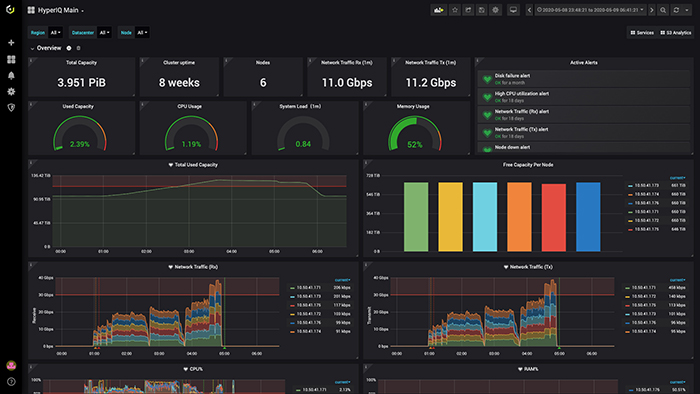
Cloudian HyperStore is a software-defined object storage platform for storing and managing large volumes of unstructured data on-premises or across hybrid clouds. It is available as stand-alone software on industry-standard servers or as Cloudian HyperStore appliances. The platform uses a peer-to-peer, shared-nothing architecture in which every node runs the same software and participates in serving I/O, so there is no central controller and no single point of failure in the data path.
Data protection is set per bucket using replication or Intel ISA-L erasure coding, and protection can span drives, nodes, racks, and separate data centers. HyperStore presents distributed infrastructure as a single flat S3 namespace, with placement, replication, and lifecycle policies applied per bucket and enforced automatically.
Key features include:
| Criterion | Solution Fit | Key Considerations |
| Data durability | Per-bucket replication and Intel ISA-L erasure coding with configurable protection levels for very high durability | Selecting the optimal scheme per data type takes some planning |
| Resilience and fault tolerance | Peer-to-peer design with no single point of failure; protects against drive, node, rack, and site failure with self-healing | Multi-site protection rewards upfront architecture planning |
| Uptime and availability | Shared-nothing architecture and multi-site replication support continuous access, including active-active across sites | Highest availability assumes a multi-site deployment |
| Scalability and deployment flexibility | Scales out non-disruptively on standard hardware or appliances; on-prem and hybrid with high S3 compatibility | Focused on on-prem and hybrid rather than a public cloud service |
| Data immutability and ransomware protection | Object Lock (WORM), encryption in transit and at rest, IAM, RBAC, and MFA | Predictive analytics and some dashboard features continue to expand |

Best for: AI and analytics teams needing S3-compatible storage at exabyte scale
Strengths: High-performance, software-defined, runs on edge, core, or cloud
Things to consider: Enterprise support ratings trail some incumbents
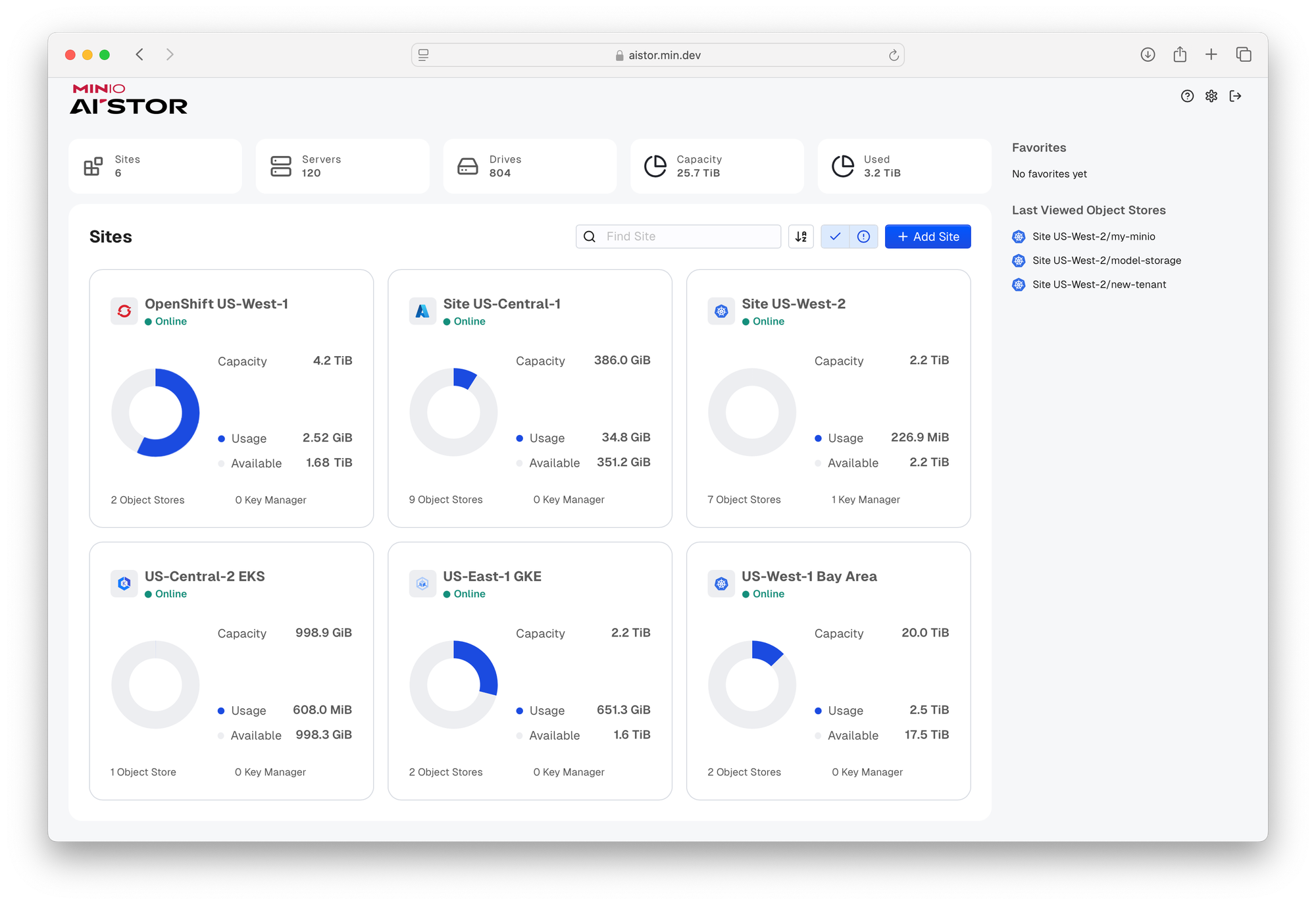
MinIO AIStor is a software-defined, S3-compatible object store built for AI and analytics workloads at any scale. It presents a flat namespace that scales from petabytes to exabytes and is designed to sustain performance as data grows. AIStor runs anywhere, from edge to core to cloud, without dependence on proprietary hardware.
It groups its capabilities into data management, data resilience, replication, versioning, and object immutability, alongside identity and access management, encryption, key management, and observability. The platform supports S3, S3 Express, Iceberg Catalog, and SFTP protocols and includes multi-tenancy support for shared environments.
Key features include:
| Criterion | Solution Fit | Key Considerations |
| Data durability | Erasure coding within its data resilience layer protects and rebuilds objects after failures | Durability tuning depends on how erasure coding is configured |
| Resilience and fault tolerance | Data resilience, replication, and versioning support recovery from component failures across environments | Resilience across sites depends on how replication is set up |
| Uptime and availability | Distributed, software-defined design supports availability at scale across edge, core, and cloud | No public SLA; availability depends on the customer-run deployment |
| Scalability and deployment flexibility | Flat namespace scales to exabytes on standard hardware; runs on edge, core, or cloud with full S3 API | Operating it well assumes in-house infrastructure skills |
| Data immutability and ransomware protection | Object immutability, anti-ransomware controls, encryption, key management server, and IAM | Enterprise support quality has been rated lower than some incumbents |

Best for: Large enterprises consolidating unstructured data across multiple sites
Strengths: Up to 14 nines durability with 100% availability during failures
Things to consider: Installation and initial setup can be complex for new teams
Scality RING is scale-out file and object storage software built for large, unpredictable workloads and cloud infrastructures. It is designed to scale in multiple dimensions, not just capacity and performance, across servers, sites, clouds, and both file and object data. RING runs on industry-standard servers with a software-defined, pay-as-you-grow model.
Data durability is provided through erasure coding, replication, and self-healing, and the scale-out, single-system design is built to maintain availability during failure events, upgrades, and expansions. Multi-geo options distribute data across availability zones so access can continue even if a full data center goes offline.
Key features include:
| Criterion | Solution Fit | Key Considerations |
| Data durability | Erasure coding, replication, and self-healing deliver up to fourteen nines of durability | Reaching top durability tiers assumes appropriate multi-site configuration |
| Resilience and fault tolerance | Self-healing plus multi-geo distribution keeps access available even if a full data center fails, with a zero RPO/RTO target | Multi-geo resilience adds architectural and resource requirements |
| Uptime and availability | Single-system scale-out designed for 100% availability during failures, upgrades, and expansions | Highest availability depends on correct multi-site deployment |
| Scalability and deployment flexibility | Multidimensional scale-out on standard servers, hybrid-cloud S3 namespace, file and object | Installation and initial setup can be complex and resource-intensive |
| Data immutability and ransomware protection | S3 Object Lock, CORE5 five-layer cyber resilience, IAM, MFA, 256-bit encryption, compliance-mode retention | Learning the full feature set takes time for teams new to the platform |
Best for: Teams wanting unified block, file, and object storage on one platform
Strengths: Three-in-one architecture with multiprotocol support and on-demand scaling
Things to consider: Setup and tuning typically require experienced administrators
IBM Storage Ceph is an enterprise-grade software-defined storage solution with a three-in-one architecture that unifies block, file, and object data in a single distributed system. It is designed to be highly scalable, reliable, and resilient while simplifying the infrastructure stack. The platform provides S3-compatible on-premises object storage with high fidelity to AWS services such as IAM, server-side encryption, and Object Lock, and it supports replication across multiple locations, including public clouds.
IBM Storage Ceph serves object storage as a service, AI/ML and data lake workloads, and platform storage for Kubernetes and OpenStack, and it can provide block storage for VMware through NVMe over TCP. It is available as software only, on Ceph-certified servers, or as a managed service.
Key features include:
| Criterion | Solution Fit | Key Considerations |
| Data durability | Distributed architecture with replication and erasure coding across the cluster protects stored data | Durability outcomes depend on cluster design and configuration |
| Resilience and fault tolerance | Self-healing distributed design and multi-location replication support recovery from failures | Synchronous replication across multiple regions can be difficult to manage |
| Uptime and availability | Highly available distributed design with round-the-clock support and proactive monitoring | Maintaining availability relies on experienced operators |
| Scalability and deployment flexibility | On-demand scale-out; software-only, certified servers, or managed service; multiprotocol | Best suited to larger deployments; less justified for small data volumes |
| Data immutability and ransomware protection | S3 Object Lock, server-side encryption, IAM, and full-stack security controls | Initial setup and tuning typically require skilled administrators |
Best for: Organizations building on AWS that need durable, elastic object storage
Strengths: Eleven nines durability and 99.99% availability backed by strong SLAs
Things to consider: Multi-dimensional pricing and egress fees can be hard to predict
Amazon Simple Storage Service (S3) is a cloud object storage service used to store and retrieve any amount of data from anywhere. It is fully elastic, growing and shrinking automatically as data is added or removed, with no need to provision capacity in advance.
Based on its architecture, S3 can provide 99.999999999% (eleven nines) of data durability and 99.99% availability by default, backed by strong SLAs among cloud providers. Data is secure, private, and encrypted by default, with fine-grained access controls and auditing to monitor requests. S3 offers multiple storage classes with automated lifecycle management, so frequently, infrequently, and rarely accessed data can be stored cost-efficiently.
Key features include:
| Criterion | Solution Fit | Key Considerations |
| Data durability | Designed for eleven nines of durability by default across its architecture | Durability is fixed by the service, with little low-level configurability |
| Resilience and fault tolerance | Replication features and AWS Backup integration support recovery and disaster readiness | Cross-region replication and retrieval add data transfer costs |
| Uptime and availability | 99.99% availability by default, backed by strong SLAs | Availability tiers and regional choices affect cost |
| Scalability and deployment flexibility | Fully elastic, scaling to exabytes with no capacity provisioning, plus broad AWS integration | Public-cloud only; deep AWS integration can create lock-in |
| Data immutability and ransomware protection | Encrypted by default with Object Lock, versioning, and fine-grained access controls | Cost-efficient protection requires lifecycle and tier planning |

Best for: Microsoft-centric enterprises storing unstructured data and data lakes
Strengths: Sixteen-nines designed durability with geo-replication and WORM options
Things to consider: Tier and access-control setup carry a learning curve
Azure Blob Storage is Microsoft’s massively scalable and secure object storage service for cloud-native workloads, archives, data lakes, high-performance computing, and machine learning. It stores unstructured data at scale and supports development frameworks including Java, .NET, Python, and Node.js. Blob Storage offers sixteen-nines of designed durability with geo-replication and the flexibility to scale as needed.
It provides multiple storage tiers, from Premium and Hot through Cool, Cold, and Archive, with automated lifecycle management to move data to lower-cost tiers over time. Security includes Microsoft Entra ID authentication, role-based access control, encryption at rest, and advanced threat protection.
Key features include:
| Criterion | Solution Fit | Key Considerations |
| Data durability | Sixteen-nines of designed durability with geo-replication across regions | The redundancy option chosen (local vs geo) affects both durability and cost |
| Resilience and fault tolerance | Geo-replication supports recovery across regions | Cross-region and retrieval activity add data transfer charges |
| Uptime and availability | Highly available object storage across Azure regions with tiered service options | Availability level depends on redundancy and tier selection |
| Scalability and deployment flexibility | Scales to petabytes and integrates tightly with the Azure ecosystem and analytics services | Public-cloud only; third-party integration outside Azure can need custom work |
| Data immutability and ransomware protection | Immutable WORM storage, encryption at rest, Entra ID, RBAC, and threat protection | Access control and tier setup carry a steeper learning curve |
Best for: Backup and archive workloads needing predictable, low-cost storage
Strengths: Single hot tier with no egress or API fees and eleven nines durability
Things to consider: 90-day minimum storage duration and 1TB minimum charge
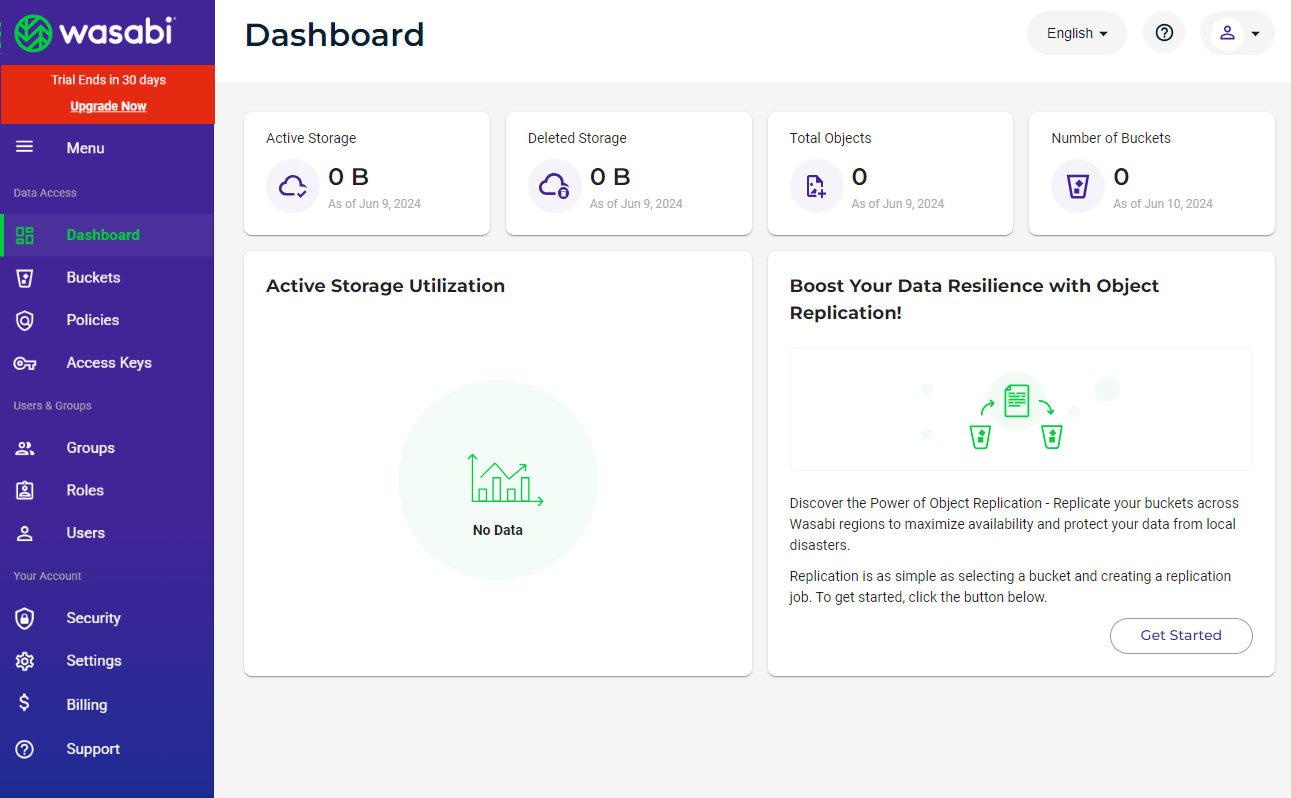
Wasabi Hot Cloud Storage is a cloud object storage service that treats all data as one hot tier rather than splitting it across storage classes. It is priced at a flat rate with no fees for egress or API requests, which Wasabi positions as up to 80% less than the hyperscalers.
The service is 100% AWS S3 and IAM API compatible, so it integrates with S3-compatible tools and workflows. Wasabi states 99.9% system availability and eleven nines of data durability, with data held in SOC-2 and ISO 27001-certified data centers. Security features include server-side encryption, MFA, IAM, SSO, built-in immutability, and a virtual air-gap capability called Covert Copy.
Key features include:
| Criterion | Solution Fit | Key Considerations |
| Data durability | Eleven nines of data durability with data stored redundantly | Durability level is fixed by the service |
| Resilience and fault tolerance | Object replication supports redundancy and local access across regions | Fewer regions than hyperscalers limit geographic redundancy options |
| Uptime and availability | States 99.9% system availability | 99.9% is a lower availability target than the hyperscalers’ 99.99% |
| Scalability and deployment flexibility | Scales without capacity limits, is S3-compatible, and spans 16 storage regions | Single tier only, with no cold or archive tiering for short-lived data |
| Data immutability and ransomware protection | Object immutability, Covert Copy virtual air-gap, encryption, MFA, IAM, and SSO | 90-day minimum storage duration and 1TB minimum charge affect high-churn or small workloads |

Best for: Backup, archive, and app storage needing low-cost S3-compatible storage
Strengths: Always-hot S3-compatible storage with free egress up to 3x storage
Things to consider: Fewer regions and advanced features than the hyperscalers
Backblaze B2 Cloud Storage is an always-hot, S3-compatible object storage service aimed at backup, archive, application storage, and AI workloads. It emphasizes a low total cost of ownership with predictable pricing and free egress up to three times a customer’s average monthly storage.
The platform integrates with existing tech stacks through the S3-compatible API, native API, CLI, and web UI, fitting multi-cloud and hybrid-cloud strategies. Backblaze provides enterprise-grade security and compliance, including encryption, Object Lock for immutability, and multi-region replication. It also offers related products such as B2 Overdrive for high-throughput workloads and Powered by Backblaze for partners building storage services.
Key features include:
| Criterion | Solution Fit | Key Considerations |
| Data durability | Designed for high durability with data stored redundantly on distributed hardware | Durability level is fixed by the service |
| Resilience and fault tolerance | Cloud Replication copies data across regions for redundancy and disaster readiness | Fewer data centers limit geographic redundancy and data sovereignty options |
| Uptime and availability | Always-hot storage with instant access to data | Fewer native integrations for event-driven, high-availability architectures |
| Scalability and deployment flexibility | Scales on demand, is S3-compatible, and fits hybrid and multi-cloud stacks | Single storage class and fewer advanced features than the hyperscalers |
| Data immutability and ransomware protection | Object Lock (WORM), encryption, fine-grained API keys, and access logging | Regions cannot be switched after account creation; free egress is capped at 3x storage |

Choosing a storage solution is ultimately about matching technical capabilities to business requirements rather than chasing the highest durability or availability figures alone. Evaluate how each option protects data, recovers from failures, scales with future growth, and supports security features such as immutability and encryption. By comparing these criteria together, organizations can select a platform that delivers the right balance of reliability, operational flexibility, and long-term data protection for their workloads.
See Cloudian first in Google Search

