


Request a Demo
Join a 30 minute demo with a Cloudian expert.
TL;DR: Enterprise storage for AI delivers the throughput, low latency, and petabyte-to-exabyte scale that GPU training and inference demand. Best for object storage: Cloudian HyperStore; best for for high-performance file workloads: VAST Data and WEKA.
Enterprise AI storage requires ultra-fast NVMe flash and parallel file or object systems. Training needs massive throughput to feed GPUs. Inference needs sub-millisecond latency for fast, real-time responses. Storage pipelines must scale seamlessly from raw data collection to final production use.
Unlike traditional storage, these systems must manage not only vast amounts of data but also enable rapid data access, high throughput, and seamless scalability. AI projects often require ingesting, processing, and analyzing massive datasets at speeds and scales that exceed the capabilities of standard enterprise storage solutions. As a result, AI-ready storage is purpose-built to handle these requirements reliably and efficiently.
Key requirements of enterprise storage for AI training and inference include:
This is part of a series of articles about AI infrastructure
In this article:
The table below summarizes the key differences between the solutions covered in this article. We explore each of them in more detail in the sections that follow.
| Category | Solution | Best For | Key Strengths | Things to Consider |
| Object Storage Platforms | 1. Cloudian HyperStore | On-prem, S3-native object storage for data-centric AI | Native S3, GPUDirect throughput, multi-tenancy, ransomware defense | Capacity dashboard and some S3 feature parity still maturing |
| Object Storage Platforms | 2. MinIO AIStor | S3-compatible object storage for training and inference | Software-defined, exabyte single namespace, broad S3 support | Monitoring depth and clustering docs need in-house expertise |
| Object Storage Platforms | 3. Scality RING | Object storage across the full AI data pipeline | Multi-protocol, 14-nines durability, CORE5, RING XP flash tier | Setup complexity and frequent patching add overhead |
| High-Performance File and Parallel Storage | 4. VAST Data Platform | Unified all-flash platform for the entire AI pipeline | DASE all-flash, multiprotocol, data reduction, RAG engine | Write throughput trails reads; premium pricing |
| High-Performance File and Parallel Storage | 5. WEKA NeuralMesh | Feeding GPU clusters for training and inference | Microsecond latency, zero-tuning, multiprotocol, tiering | Newer platform; benefits depend on fast networking and NVMe |
| High-Performance File and Parallel Storage | 6. Pure Storage FlashBlade | Unified all-flash file and object storage for AI | One OS for NFS/SMB/S3, non-disruptive upgrades, tiering | Premium pricing; limited data deduplication |
| High-Performance File and Parallel Storage | 7. DDN Data Intelligence Platform | High-throughput data fabric for large AI clusters | EXAScaler parallel file system plus Infinia object platform | Premium pricing; node-by-node upgrades take time |
| High-Performance File and Parallel Storage | 8. NetApp AFX | Enterprise disaggregated storage for AI data pipelines | ONTAP management, 4 TB/s throughput, metadata engine, AIDE | Cost and licensing complexity; CLI-heavy management |
AI workloads generate and consume enormous amounts of data, often far exceeding the capacity of conventional storage systems. Modern AI models are trained on datasets that can range from terabytes to petabytes, and these datasets are continually growing as organizations collect more information from sensors, logs, user interactions, and other sources.
Traditional storage solutions struggle to keep up with this scale, leading to bottlenecks that slow down AI development cycles and model training times. The velocity at which data is generated and needs to be ingested also presents a significant challenge. AI applications often require near-real-time access to fresh data for tasks such as continuous learning or adaptive inference.
How enterprise storage helps:
Without storage systems built to handle both the volume and speed of this data, organizations risk underutilizing their AI infrastructure and failing to achieve optimal results from their models.
AI training and inference tasks are typically accelerated by GPUs, which can process data orders of magnitude faster than traditional CPUs. However, to fully utilize these GPUs, the underlying storage must deliver data at a rate that matches the GPUs’ processing speed. If the storage cannot keep up, GPUs become idle, resulting in wasted computational resources and increased costs.
High-throughput data access is especially critical during model training, when large datasets must be streamed continuously to multiple GPUs in parallel. This requires storage architectures that can deliver sustained, multi-gigabyte-per-second throughput without interruption or latency spikes.
How enterprise storage helps:
Enterprise storage for AI addresses this need by employing technologies such as NVMe drives, high-speed networking, and parallel file systems, ensuring that data pipelines remain unimpeded.
Related content: Read our guide to NVIDIA GPUDirect Storage, its key features and use cases.
Inference (the process of making predictions using trained AI models) requires low-latency data access, especially in real-time applications like fraud detection, autonomous vehicles, or interactive AI assistants.
Delays in fetching input data or storing output predictions can severely impact the user experience and, in some cases, jeopardize safety or compliance. As AI expands into latency-sensitive domains, the need for responsive storage systems becomes more pronounced.
How enterprise storage helps:
To meet these requirements, enterprise storage for AI is optimized for rapid data retrieval and minimal I/O wait times. Technologies such as solid-state drives (SSDs), memory caching, and tiered storage architectures are leveraged to reduce latency. These features ensure that inference workloads can deliver results within strict time constraints, enabling organizations to deploy AI solutions in environments where every millisecond counts.
AI workloads span a wide range of data types, from structured tabular data used in traditional analytics to unstructured formats such as images, video, audio, and text. Effective AI storage solutions must support seamless ingestion, storage, and retrieval of both structured and unstructured data. This flexibility is crucial for organizations that deploy diverse AI models across different business functions.
How enterprise storage helps:
Enterprise storage for AI incorporates features that enable efficient management of heterogeneous data types. These systems often support object storage, file storage, and database integration within a unified platform.
AI training processes involve reading and writing large volumes of data in a sequential manner, especially when dealing with image or video datasets. High sequential throughput is essential to prevent I/O bottlenecks that can stall model training and reduce overall efficiency. Enterprise storage for AI is engineered to maximize read and write speeds by using technologies such as:
Maintaining high throughput is not only critical during training but also during data preprocessing and augmentation steps, which are common in AI pipelines. If the storage system cannot keep pace with these operations, downstream tasks are delayed, negatively impacting project timelines. By investing in storage architectures that prioritize sequential performance, organizations can ensure that their AI workloads run smoothly from start to finish.
Modern AI models are often trained on clusters of GPUs working in parallel to accelerate learning. These clusters require simultaneous access to the same training data, which places significant demands on the storage infrastructure. Enterprise storage for AI must be capable of serving data to hundreds or thousands of GPUs without contention or performance degradation.
To achieve this, storage solutions use:
These technologies ensure that each GPU node receives the data it needs without waiting for other nodes to finish their operations. As a result, AI training jobs scale efficiently across large clusters, reducing training times and enabling the use of more complex models.
Quick access to training data is a foundational requirement for efficient AI development. Data scientists frequently iterate on models, requiring rapid retrieval of different datasets or data subsets for experimentation. Slow storage systems can hinder this process, forcing teams to wait for data to load before they can proceed with training or validation.
Enterprise storage for AI addresses this need by:
These features reduce wait times and enable more agile model development cycles. Fast data access also supports better utilization of expensive GPU resources, ensuring that hardware investments translate directly into productivity gains.
Distributed file systems are critical for supporting the scale and performance requirements of AI workloads. They allow data to be stored and accessed across multiple servers, providing a unified namespace and enabling seamless data sharing among compute nodes. This is especially important for AI training jobs that run on large clusters and require concurrent access to shared datasets.
Enterprise storage for AI often integrates distributed file systems such as:
These systems are designed to handle petabyte-scale data volumes while maintaining high throughput and low latency. By supporting distributed architectures, organizations can scale their storage infrastructure in line with growing AI demands without compromising performance.
AI training jobs can be lengthy and resource-intensive, making them susceptible to interruptions from hardware failures, power outages, or software errors. Rapid recovery capabilities in enterprise storage are essential to minimize lost time and computational resources when such failures occur. Organizations can resume training from the point of failure rather than starting over, using features such as:
These recovery mechanisms not only reduce downtime but also improve overall workflow resilience. By ensuring that progress is preserved and can be quickly restored, enterprise storage systems help maintain the momentum of AI projects. This reliability is particularly valuable in production environments where delays or data loss can have significant operational or financial impacts.
How we selected these solutions: We shortlisted enterprise storage platforms for AI based on high-throughput data delivery to GPUs, low-latency access for training and inference, scalability from petabytes to exabytes, support for both structured and unstructured data, and enterprise-grade security and resilience.

Best for: On-prem, S3-native object storage for data-centric AI
Strengths: Native S3, GPUDirect throughput, multi-tenancy, ransomware defense
Things to consider: Capacity dashboard and some S3 feature parity still maturing
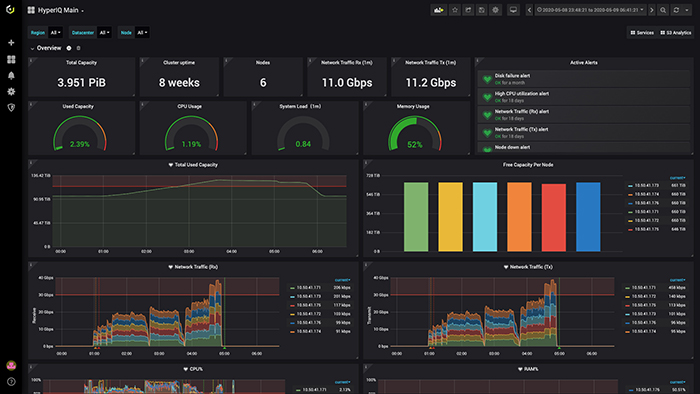
Cloudian HyperStore is an S3-compatible object storage platform for managing large volumes of unstructured data across on-premises and multi-cloud environments. It is built on a shared-nothing, peer-to-peer architecture in which every node serves I/O, with no metadata server, head node, or central controller in the data path. Adding a node adds CPU, memory, network, and disk at the same time, so throughput scales linearly with capacity.
For AI, HyperStore provides direct parallel access through its S3 API, supporting thousands of concurrent operations. It supports NVIDIA GPUDirect and RDMA for S3-compatible storage, along with data-locality optimization and all-flash configuration options, to move data from storage to GPUs while bypassing CPU bottlenecks. The platform is software-defined and runs on Cloudian appliances or industry-standard servers.
Key features include:
Limitations (as reported by users on G2):

Best for: S3-compatible object storage for AI training and inference
Strengths: Software-defined, exabyte single namespace, broad S3 support
Things to consider: Monitoring depth and clustering docs need in-house expertise
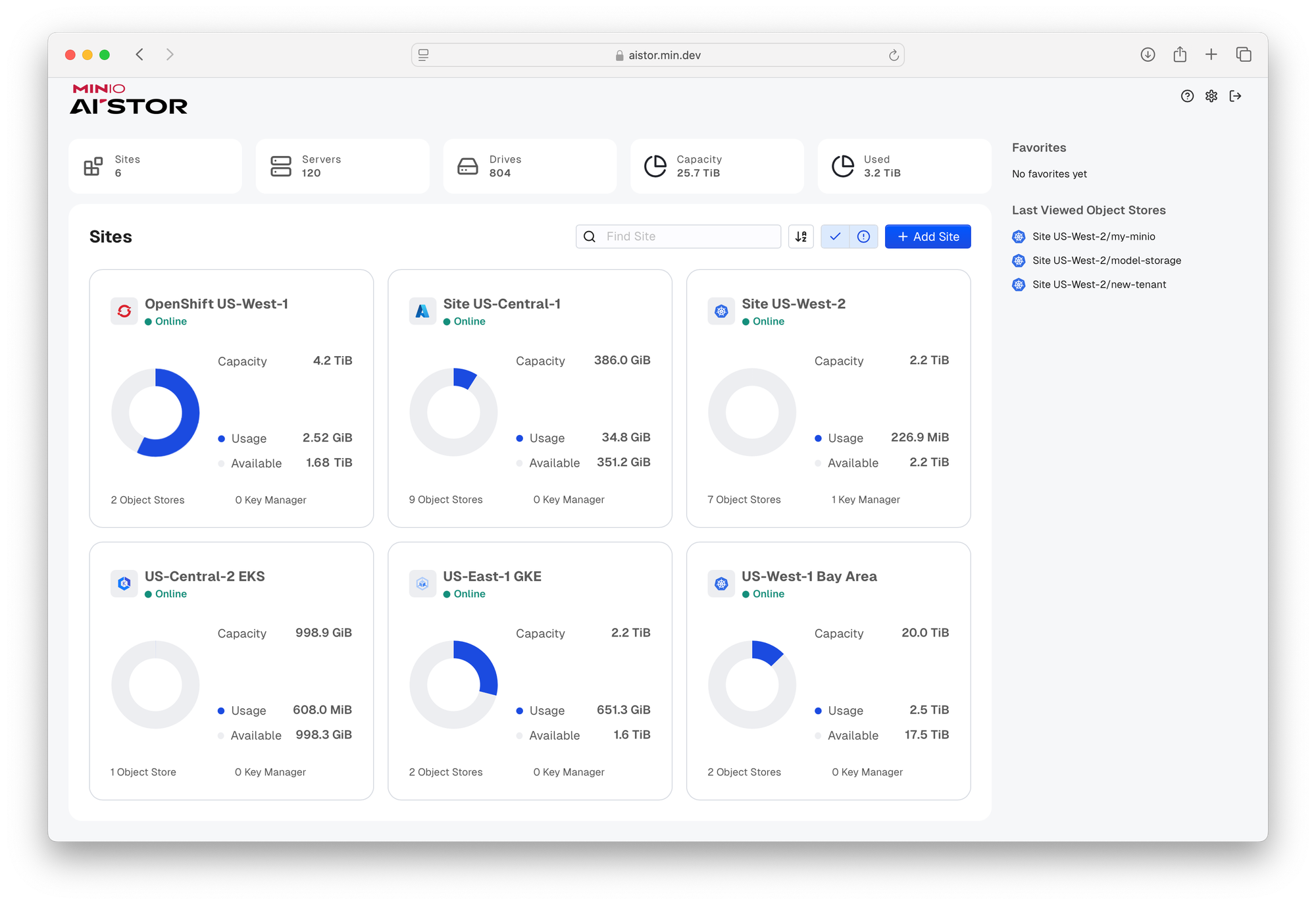
MinIO AIStor is a software-defined, S3-compatible object store designed for AI and analytics workloads at scale. It uses a flat namespace that grows from petabytes to exabytes without breaking into separate systems, and its distributed architecture is built to sustain performance as deployments expand across clusters, data centers, and clouds. It can run on the edge, in the core, or in the cloud.
AIStor targets AI pipelines with low-latency access and high concurrency for training, inference, and fine-tuning. It connects to storage through the S3 API and other interfaces, and integrates with common AI and analytics frameworks. A separate product, MemKV, provides a context memory store for AI inference.
Key features include:
Limitations (as reported by users on G2):

Best for: Object storage across the full AI data pipeline
Strengths: Multi-protocol, 14-nines durability, CORE5, RING XP flash tier
Things to consider: Setup complexity and frequent patching add overhead
Scality RING is scale-out file and object storage software designed for large, unpredictable workloads. It scales in multiple dimensions, including capacity, performance, and number of buckets, across servers, sites, and clouds, and presents a hybrid-cloud S3 namespace from a single system. The software runs on industry-standard servers under a usable-capacity subscription model.
For AI, Scality positions RING as a repository across the pipeline, from ingesting and preparing datasets to training, checkpointing, and inference. Its all-flash configuration, RING XP, adds a performance tier with microsecond-level latency for small objects, aimed at model training, fine-tuning, and real-time inference where GPUs must stay fed.
Key features include:
Limitations (as reported by users on PeerSpot):
Best for: Unified all-flash platform for the entire AI pipeline
Strengths: DASE all-flash, multiprotocol, data reduction, RAG engine
Things to consider: Write throughput trails reads; premium pricing
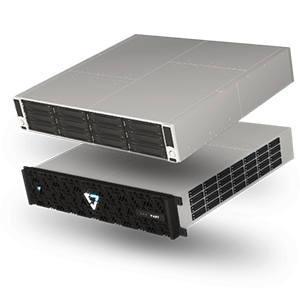
The VAST Data Platform is an all-flash data platform built on an architecture VAST calls DASE, or Disaggregated and Shared Everything, which separates storage from compute. It unifies storage, database, and compute services into a single system and is designed to serve the AI data pipeline from data capture and preparation through model training and serving, scaling from terabytes to exabytes.
The platform handles files, objects, blocks, tables, and streaming data within one architecture, reachable through multiple protocols. It applies data reduction on flash to make an all-flash design practical at scale, and adds services for real-time analytics and retrieval-augmented generation on top of the stored data.
Key features include:
Limitations (as reported by users on PeerSpot; this is a highly rated product with limited critical reviews):

Best for: Feeding GPU clusters for training and inference
Strengths: Microsecond latency, zero-tuning, multiprotocol, tiering
Things to consider: Newer platform; benefits depend on fast networking and NVMe
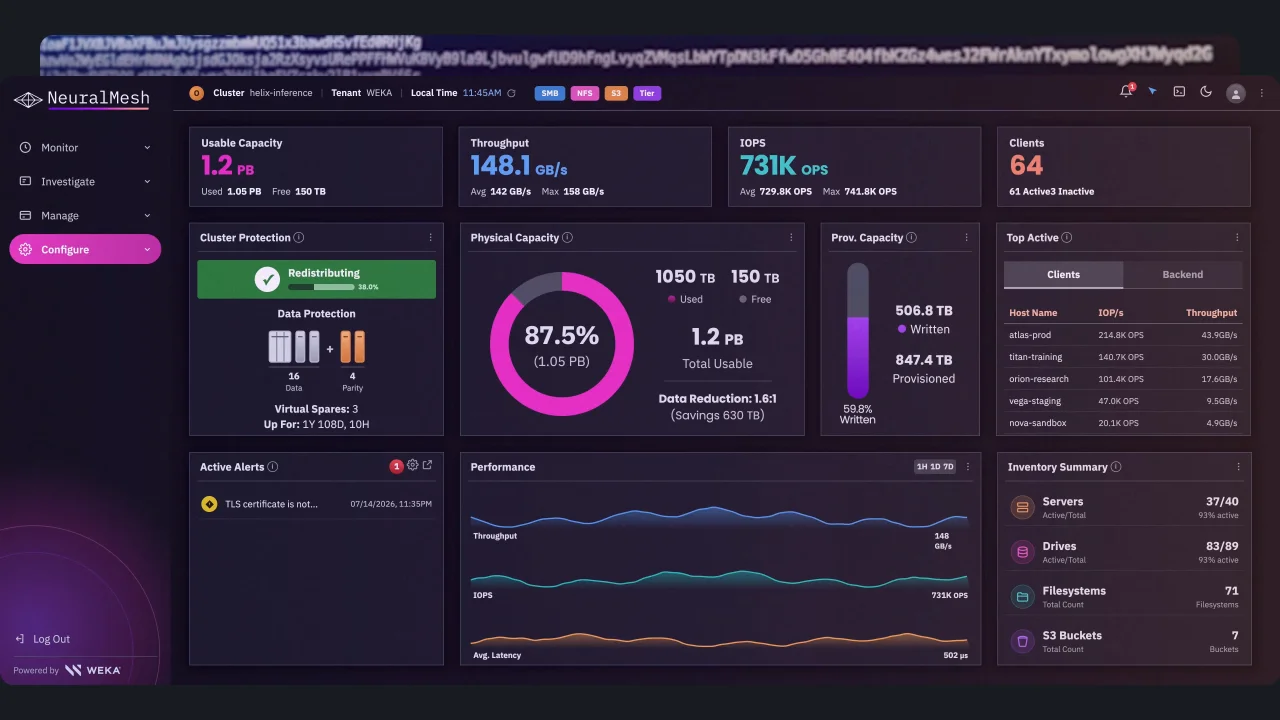
NeuralMesh by WEKA is a software-defined, fully distributed storage system built on a containerized, microservices architecture. It interconnects data, compute, and storage services and is organized into five components, Core, Accelerate, Deploy, Observe, and Enterprise Services, that handle resilience, performance, deployment, monitoring, and data services. The system is designed to become more resilient and efficient as it scales from petabytes to exabytes.
For AI and HPC, NeuralMesh combines memory and flash storage in a single low-latency pool and creates direct paths between data and applications to deliver microsecond latency at scale. It runs on bare metal, in public cloud, or in hybrid environments, and add-on capabilities extend GPU memory and fuse compute with storage.
Key features include:
Limitations (based on publicly available sources; WEKA storage is highly rated with few critical reviews):

Best for: Unified all-flash file and object storage for AI
Strengths: One OS for NFS/SMB/S3, non-disruptive upgrades, tiering
Things to consider: Premium pricing; limited data deduplication
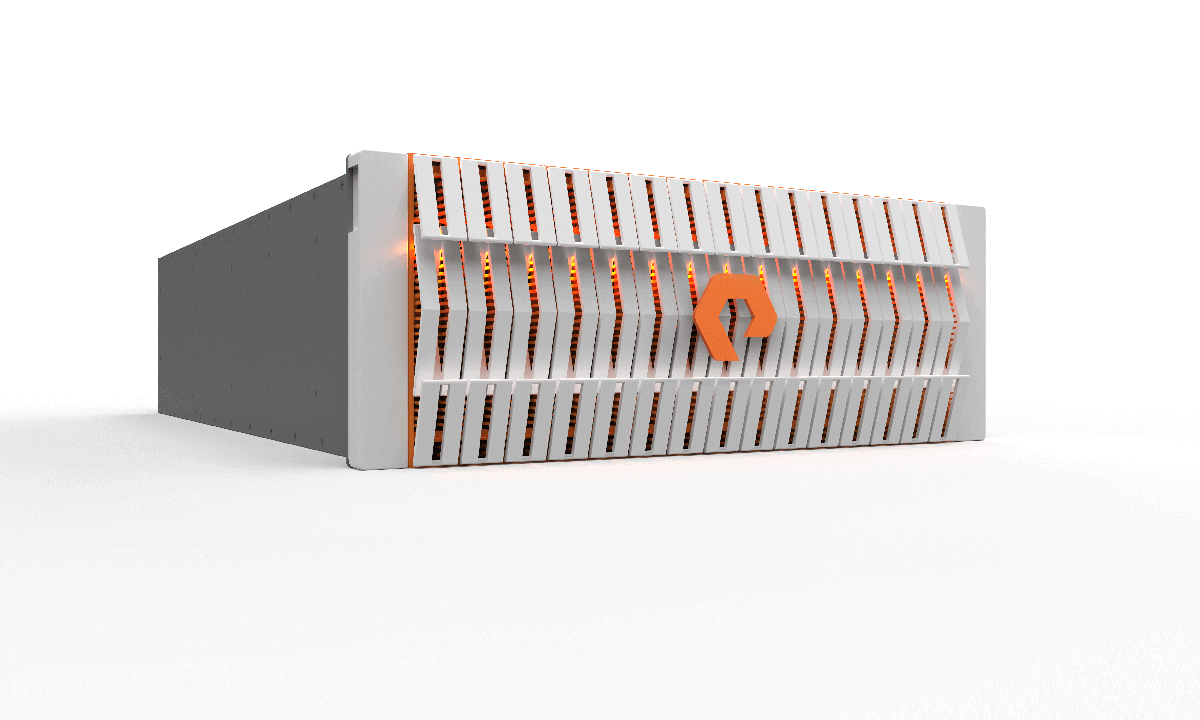
Pure Storage FlashBlade, from the vendor now operating under the Everpure brand, is a unified all-flash file and object storage array that runs native NFS, SMB, and S3 on a single operating system, Purity//FB, without gateways or protocol forks. It is a scale-out platform that treats files and objects as equals, and it upgrades blades, modules, and software without downtime.
The FlashBlade line spans three models: FlashBlade//E for capacity-oriented workloads, FlashBlade//S for high-performance file and object use including AI training and inference, and FlashBlade//EXA for large-scale AI and HPC. It integrates with NVIDIA DGX SuperPOD, Apache Spark, and Splunk, and includes immutable snapshots and always-on encryption.
Key features include:
Limitations (as reported by users on PeerSpot):

Best for: High-throughput data fabric for large AI clusters
Strengths: EXAScaler parallel file system plus Infinia object platform
Things to consider: Premium pricing; node-by-node upgrades take time
The DDN Data Intelligence Platform is built from two components that together form an AI data fabric across on-premises, cloud, and edge environments. EXAScaler is a parallel file system, based on Lustre, aimed at high-throughput AI and HPC workloads, while Infinia is a software-defined, multi-protocol platform for inference, data analytics, data preparation, and model loading. The platform integrates closely with NVIDIA and scales from terabytes to exabytes.
DDN positions the platform for large GPU environments, citing deployments spanning tens of thousands of GPUs and large numbers of concurrent clients. It uses metadata-driven data management to reduce data movement and keep GPUs supplied during training, checkpointing, and inference, and supports secure multi-tenancy for shared and sovereign AI environments.
Key features include:
Limitations (as reported by users on PeerSpot):

Best for: Enterprise disaggregated storage for AI data pipelines
Strengths: ONTAP management, 4 TB/s throughput, metadata engine, AIDE
Things to consider: Cost and licensing complexity; CLI-heavy management
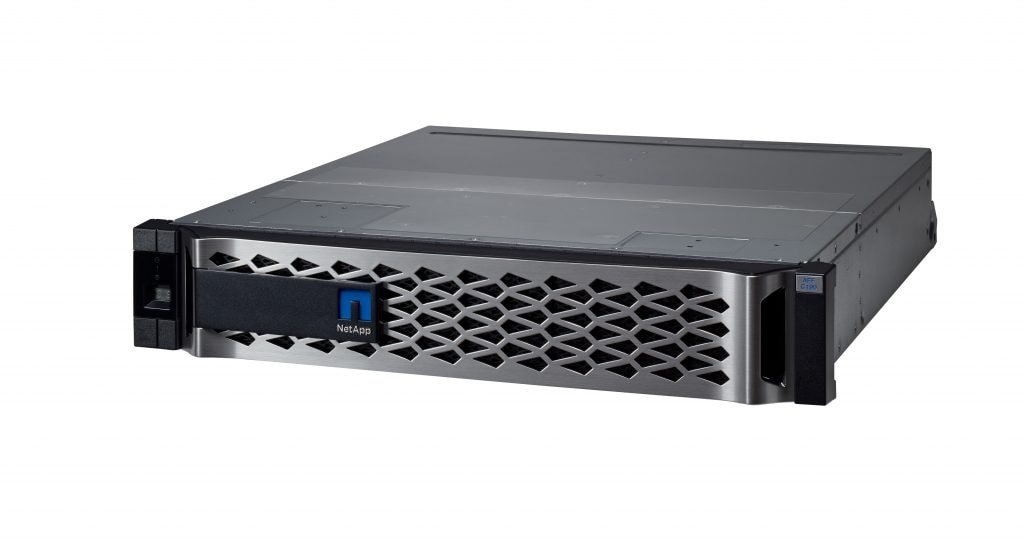
NetApp AFX is a disaggregated storage system for enterprise AI, built on NetApp ONTAP. It separates compute from storage so the two scale independently and linearly, with granular QoS, and it integrates into a hybrid multi-cloud data estate. AFX is certified for NVIDIA DGX SuperPOD and pairs with the NetApp AI Data Engine to move data through the AI pipeline from preparation to application deployment.
The system delivers high throughput and large capacity in a single cluster while carrying ONTAP’s data management and security features. An always-current metadata engine helps teams find and curate datasets, and real-time ransomware detection and fine-grained access controls protect data as it moves across environments.
Key features include:
Limitations (as reported by users on PeerSpot; drawn from the ONTAP-based NetApp AFF line that AFX is built on):
Enterprise AI initiatives depend on storage infrastructure that can deliver consistent throughput, low latency, and seamless scalability as datasets and GPU environments continue to grow. By adopting storage platforms designed for parallel access, distributed architectures, strong data protection, and support for both structured and unstructured data, organizations can accelerate model development, improve infrastructure utilization, and build AI environments that remain performant and resilient from data ingestion through training, inference, and long-term data management.
See Cloudian first in Google Search

