


Request a Demo
Join a 30 minute demo with a Cloudian expert.
TL;DR: Storage systems for massive unstructured AI datasets ingest, store, and serve petabytes to exabytes of text, images, video, and embeddings for AI training and inference. Best for object storage: Cloudian; extreme performance: VAST Data, WEKA; enterprise unified data: NetApp.
Storage for massive unstructured AI datasets (text, images, video) requires high-performance architectures. Solutions rely on a combination of Object Storage for scalable, long-term capacity, and NVMe Flash for high-speed local data caching during model training and inference.
Storage architectures include:
This is part of a series of articles about AI infrastructure
In this article:
The table below summarizes the key differences between the storage systems covered in this guide. We explore each of them in more detail in the sections that follow.
| Category | Solution | Best For | Key Strengths | Things to Consider |
| Object Storage Platforms | Cloudian HyperStore | On-prem S3 object storage for unstructured AI data | Shared-nothing scale-out, S3 parallel access, GPUDirect | Monitoring UI and customization could be simpler |
| Object Storage Platforms | Scality RING | Exabyte-scale AI data lakes and long-term corpora | Multi-dimensional scaling, CORE5 cyber resilience | Frequent patches; UI mainly for administration |
| Object Storage Platforms | MinIO AIStor | Software-defined S3 storage for AI and analytics | Flat namespace to exabytes, S3 API, framework integration | Documentation gaps; monitoring needs work |
| High-Performance & Unified Storage | VAST Data Platform | All-flash consolidation of unstructured and structured data | DASE architecture, single flash tier, data reduction | Write slower than read; some features maturing |
| High-Performance & Unified Storage | WEKA (NeuralMesh) | GPU-bound AI training and inference at scale | Microsecond latency, multi-protocol, self-healing | Newer platform; certified-hardware requirements |
| High-Performance & Unified Storage | DDN | Large GPU clusters and AI factories | Parallel file system + object, TB/s throughput | Rigid file-system growth; management could improve |
| High-Performance & Unified Storage | Everpure FlashBlade | Unified fast file and object for AI and HPC | Native NFS/SMB/S3, all-flash, non-disruptive upgrades | High price; compression-only data reduction |
| High-Performance & Unified Storage | NetApp AFX | Enterprise AI pipelines on proven ONTAP data management | Disaggregated ONTAP, metadata engine, ransomware defense | Setup complexity; licensing cost and CLI reliance |
AI workloads place different demands on storage than traditional analytics. Training jobs often read millions or billions of files, move data across many GPUs, and repeat access patterns across multiple experiments. This creates pressure on throughput, metadata handling, and scaling:
Object storage is a flat, scalable architecture where data is stored as discrete objects, each with associated metadata and a unique identifier. This model is well-suited for unstructured data because it can efficiently handle billions of files of varying sizes, from tiny log files to massive video datasets. Object storage platforms, such as Amazon S3 or MinIO, are designed for horizontal scaling, allowing organizations to grow their storage capacity as data volumes increase without sacrificing performance or manageability.
The metadata-driven nature of object storage also supports advanced data management and search capabilities, which are critical for AI applications that require rapid data discovery and retrieval. Unlike hierarchical file systems, object storage does not rely on directory structures, enabling faster and more flexible access patterns. This architecture also integrates well with cloud-native workflows, providing APIs for programmatic access.
Distributed file systems, such as Hadoop Distributed File System (HDFS) or Google File System (GFS), spread data across multiple servers to provide redundancy, scalability, and fault tolerance. These systems present a unified file namespace, making it easy for AI workloads to access and process large datasets as if they were stored locally, even when the data is physically distributed across many nodes. This design is crucial for high-throughput AI training jobs that require simultaneous access to large files by multiple compute nodes.
By enabling parallel reads and writes, distributed file systems can keep up with the data ingestion and processing demands of AI pipelines. They also incorporate features like replication and erasure coding to ensure data durability and availability, even in the event of hardware failures. However, while distributed file systems are robust and scalable, they may introduce complexity in managing metadata and require careful tuning to optimize performance for specific AI workloads.
Network Attached Storage (NAS) provides file-level storage over a network, allowing multiple users and systems to share access to centralized data repositories. In AI environments, NAS devices are often used for collaborative projects or as a shared workspace for data scientists and engineers. NAS solutions offer familiar file system interfaces (such as NFS or SMB), making integration with existing tools and workflows straightforward.
However, traditional NAS systems can become performance bottlenecks as AI workloads scale, especially when handling high volumes of small files or concurrent access from many clients. Modern, scale-out NAS solutions address these limitations by distributing both storage and processing across multiple nodes, providing better throughput and resilience. Still, for extremely large unstructured AI datasets, NAS may be best suited as a component of a broader, hybrid storage strategy rather than the sole solution.
Data lakes are centralized repositories that store raw, unstructured, and structured data at scale, making them a popular choice for AI and analytics workloads. They enable organizations to collect and retain data in its native format, supporting downstream processing and feature extraction for AI models. Data lakes are typically built on top of object storage systems, leveraging their scalability and cost efficiency.
Lakehouse storage is an evolution of the data lake concept, blending the flexibility of data lakes with the data management features of data warehouses. Lakehouse architectures introduce support for ACID transactions, schema enforcement, and advanced indexing, making it easier to manage large, dynamic datasets required for AI projects. This hybrid approach allows teams to maintain data quality and consistency while still benefiting from the scalability and flexibility needed for massive AI datasets.
Vector databases are designed to store, index, and search high-dimensional vector representations of unstructured data, such as embeddings produced by AI models. These databases are critical for tasks like similarity search, recommendation engines, and semantic retrieval, where traditional databases struggle with the scale and complexity of vector data. Vector storage layers often integrate with existing data lakes or object storage, enabling efficient retrieval and real-time querying of large embedding datasets.
The rise of vector databases addresses a growing need in AI workflows, where models generate billions of vectors that must be stored, indexed, and queried efficiently. Solutions for large-scale vector data offer specialized indexing algorithms and distributed architectures. These systems support rapid similarity search across massive embedding spaces, a capability that is increasingly essential for modern AI applications.
AI workloads require storage systems that can scale seamlessly to accommodate explosive data growth, often reaching petabytes or even exabytes. The system must support horizontal scaling, allowing additional storage nodes to be added without service disruption or performance degradation. This scalability ensures that organizations can handle ever-expanding datasets, which is critical as AI models become more complex and data-hungry.
Beyond raw capacity, massive scalability also means supporting millions to billions of files or objects, each potentially varying in size and access frequency. Storage architectures must efficiently manage metadata and maintain consistent performance as the system grows. The ability to scale out both storage and throughput is vital for supporting distributed AI training and inference workloads that rely on access to vast, diverse datasets.
AI model training and inference often involve reading and writing large volumes of data in parallel, placing significant demands on storage throughput. High throughput ensures that data pipelines can supply GPUs and other accelerators at their maximum processing rates, minimizing idle time and improving overall efficiency. Storage systems must be optimized for both sequential and random access patterns, as AI workloads can be unpredictable and varied.
Achieving high throughput requires careful architecture, including fast network interconnects, efficient data placement, and support for parallel I/O operations. Bottlenecks in storage throughput can slow down the entire AI workflow, leading to longer training times and delayed insights. Therefore, AI-ready storage solutions prioritize throughput alongside capacity, ensuring that data is always available at the speed required by modern compute infrastructure.
Low-latency access is essential for AI workloads that require real-time or near-real-time data retrieval, such as online inference or interactive data exploration. Storage systems must minimize response times for both large and small data requests, ensuring that compute resources are not left waiting for data. This is particularly important in distributed environments, where network and storage latency can quickly add up and impact overall system performance.
To achieve low latency, AI-ready storage architectures may leverage techniques such as caching, tiered storage, and optimized data placement. These strategies reduce the time it takes to locate and deliver data to compute nodes, supporting use cases like autonomous vehicles, robotics, and fraud detection that rely on rapid decision-making. Consistently low-latency storage is a key enabler for deploying AI models in production environments where responsiveness is critical.
Efficient metadata management is crucial when dealing with massive unstructured datasets, as it enables fast data discovery, organization, and retrieval. Metadata includes information such as file names, creation dates, labels, and custom tags, all of which help AI workflows locate and filter relevant data. Poor metadata management can lead to data sprawl, making it difficult to find the right inputs for model training or analysis.
Advanced storage systems offer metadata services, supporting rich indexing, search capabilities, and integration with data catalogs. These features empower data scientists and engineers to manage large-scale datasets effectively, track data lineage, and enforce data governance policies. Effective metadata management not only accelerates AI development but also enhances data quality and compliance across the organization.
AI datasets change continuously as new data is collected, labels are corrected, and preprocessing pipelines evolve. Storage systems need lifecycle management capabilities that automate how data moves between performance tiers, archival storage, and deletion based on age, access patterns, or business policies. This reduces storage costs while keeping frequently used datasets readily available for training and inference.
Lifecycle management also supports dataset versioning, retention policies, and reproducible machine learning workflows. Teams can preserve historical dataset versions for auditing or model comparison while automatically cleaning up temporary files, intermediate outputs, and obsolete checkpoints. These capabilities help control storage growth without sacrificing reproducibility or operational efficiency.
AI storage systems often contain sensitive business information, personal data, proprietary models, and regulated datasets. Strong security controls include encryption at rest and in transit, identity and access management, role-based access control, and detailed audit logging. These features help prevent unauthorized access while ensuring that only approved users and services can access specific datasets.
Governance extends beyond security by providing visibility into how data is collected, modified, shared, and used throughout the AI lifecycle. Storage platforms should support data lineage, policy enforcement, compliance reporting, and integration with data catalogs and governance tools. These capabilities improve trust in AI systems by making datasets easier to trace, validate, and manage across large organizations.
How we selected these systems: We shortlisted storage systems for massive unstructured AI datasets based on their ability to scale to petabytes and exabytes, deliver high-throughput and low-latency access for GPU-driven training and inference, manage rich metadata, and protect large volumes of unstructured data across on-premises, hybrid, and cloud environments.

Best for: On-premises, S3-compatible object storage for unstructured AI data.
Strengths: Shared-nothing scale-out, S3 parallel access, GPUDirect support.
Things to consider: Monitoring interface and customization could be more intuitive.
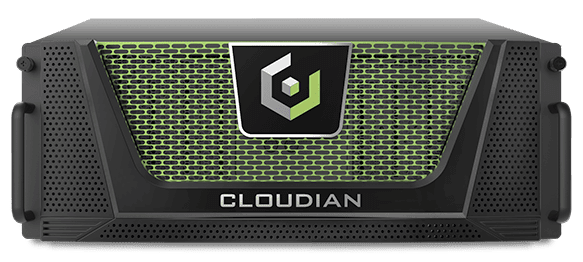
Cloudian HyperStore is S3-compatible object storage software for storing and managing large volumes of unstructured data on-premises and across multiple sites. It is built on a shared-nothing, peer-to-peer architecture with no central metadata server, head node, or single point of failure in the data path.
Every node participates equally in serving I/O, so adding a node adds CPU, memory, network, and disk to the cluster at the same time, and throughput scales alongside capacity. HyperStore presents distributed infrastructure across data centers, edge sites, and cloud regions as a single, flat S3 namespace managed through one set of credentials and one control plane.
Key features include:
Limitations (as reported by users on G2):

Best for: Exabyte-scale AI data lakes and long-term training corpora.
Strengths: Multi-dimensional scaling with CORE5 cyber resilience.
Things to consider: Frequent patches and a UI focused mainly on administration.
Scality RING is software-defined object storage that aggregates data from across the AI pipeline into a single, scalable data lake on standard x86 servers. It uses a patented MultiScale architecture that scales in multiple dimensions, including capacity, performance, buckets, and sites, and can grow from hundreds of terabytes to hundreds of petabytes.
RING exposes S3 object plus NFS and SMB file interfaces from one system and can run on hybrid flash/HDD or all-flash servers. An all-flash configuration, RING XP, adds a simplified object API for small-object AI workloads, while metadata is held on flash to accelerate common S3 operations and support metadata tagging and search.
Key features include:
Limitations (as reported by users on PeerSpot):

Best for: Software-defined, S3-compatible storage for AI and analytics.
Strengths: Flat namespace to exabytes with broad AI framework integration.
Things to consider: Documentation gaps and limited built-in monitoring.
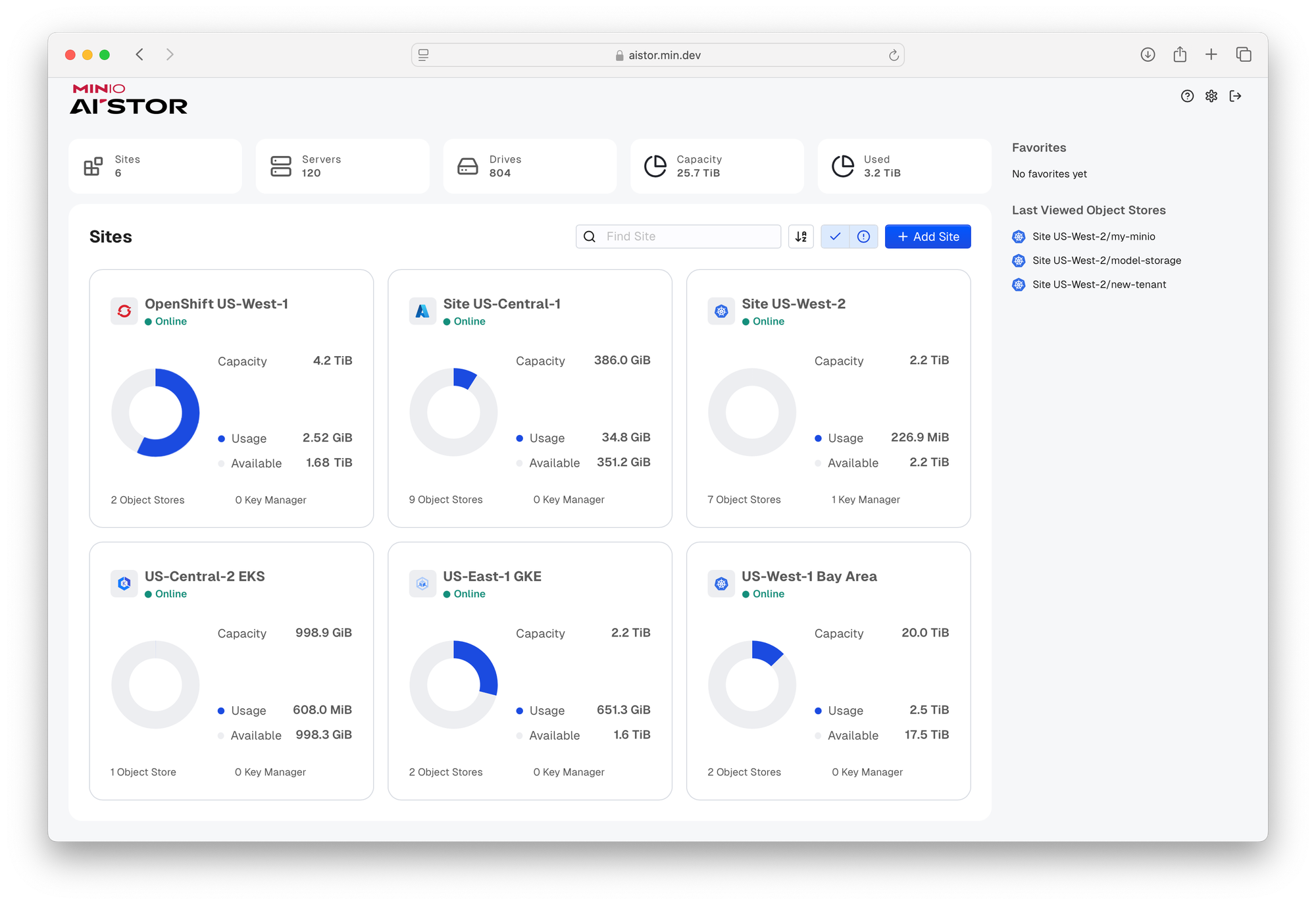
MinIO AIStor is a software-defined, S3-compatible object store for AI and analytics workloads. It scales linearly in a single flat namespace from terabytes to exabytes and runs on commodity hardware at the edge, core, or cloud, with no proprietary appliance requirement.
AIStor uses a stateless architecture that manages metadata within the storage layer rather than an external metadata database, which the vendor positions as a way to avoid database bottlenecks as object and bucket counts grow. It stores structured and unstructured data together and connects to common AI frameworks and table formats.
Key features include:
Limitations (as reported by users on G2):
Best for: All-flash consolidation of unstructured and structured AI data.
Strengths: DASE architecture and data reduction bring flash to archive economics.
Things to consider: Write performance trails read, and some features are maturing.
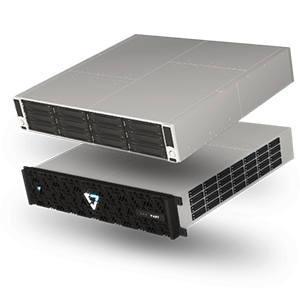
The VAST Data Platform is a scale-out, all-flash system for unstructured and structured data that eliminates storage tiering. Its DataStore is the storage foundation, exposing enterprise file (NFS, SMB) and object (S3) interfaces and built to serve AI computing architectures such as NVIDIA DGX SuperPOD, alongside HPC and analytics.
The platform is built on a Disaggregated and Shared-Everything (DASE) architecture that separates compute from storage so each can scale independently. VAST applies data reduction to bring archive-like economics to flash, enabling a single flash tier at exabyte scale, and adds database, compute, and metadata capabilities on the same foundation.
Key features include:
Limitations (as reported by users on Gartner Peer Insights):

Best for: GPU-bound AI training and inference at large scale.
Strengths: Microsecond latency, multi-protocol access, self-healing at scale.
Things to consider: Newer platform with certified-hardware requirements.
WEKA’s NeuralMesh is a software-defined, container-native storage system built as a fully distributed parallel file system for AI and data-intensive workloads. It runs on standard x86 and ARM infrastructure across on-premises, cloud, and hybrid environments without custom hardware, and is delivered as containerized microservices managed through a Kubernetes Operator.
The architecture is organized into components for core storage, acceleration, deployment, observability, and enterprise services. It combines memory and NVMe flash in a low-latency pool, distributes metadata across the system, and tiers cold data to object storage while keeping hot data and metadata on flash.
Key features include:
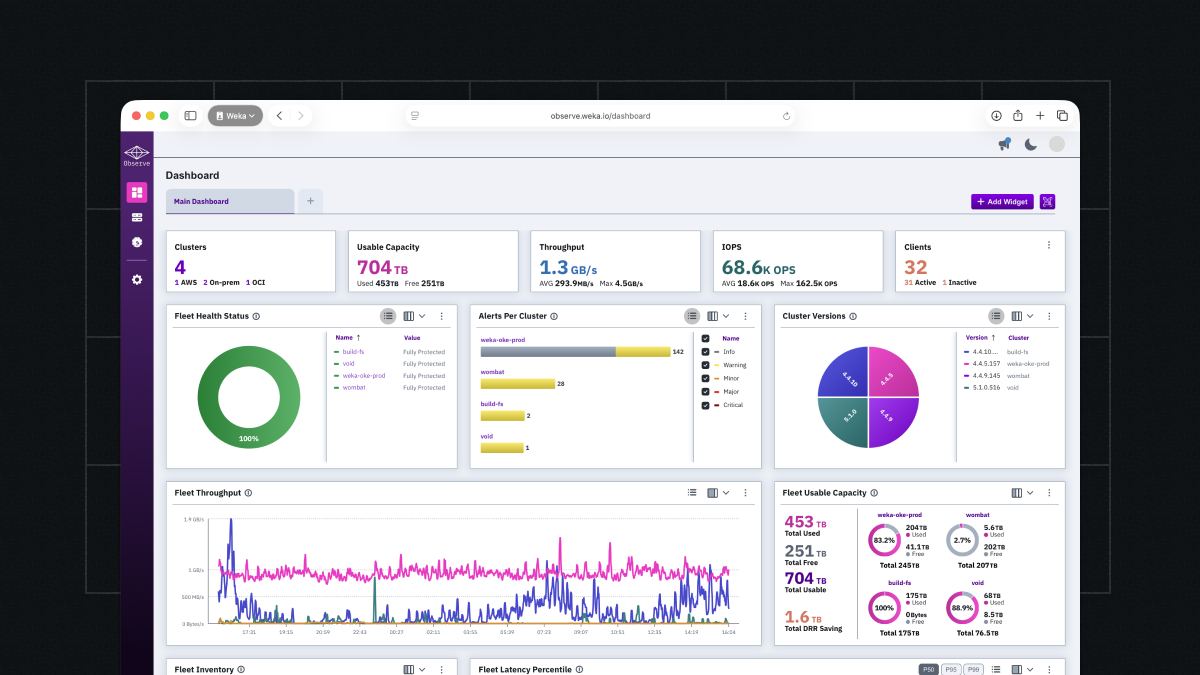
Observability: Multi-cluster dashboards, real-time throughput, latency, and IOPS metrics, client-level diagnostics, smart alerting, and Prometheus export.
Limitations (as reported by users on Gartner Peer Insights): WEKA is highly rated with few strongly negative reviews, so the points below are drawn from critical feedback and publicly available sources.

Best for: Large GPU clusters and AI factories at scale.
Strengths: Parallel file system plus object storage with TB/s throughput.
Things to consider: Rigid file-system growth and management tooling.
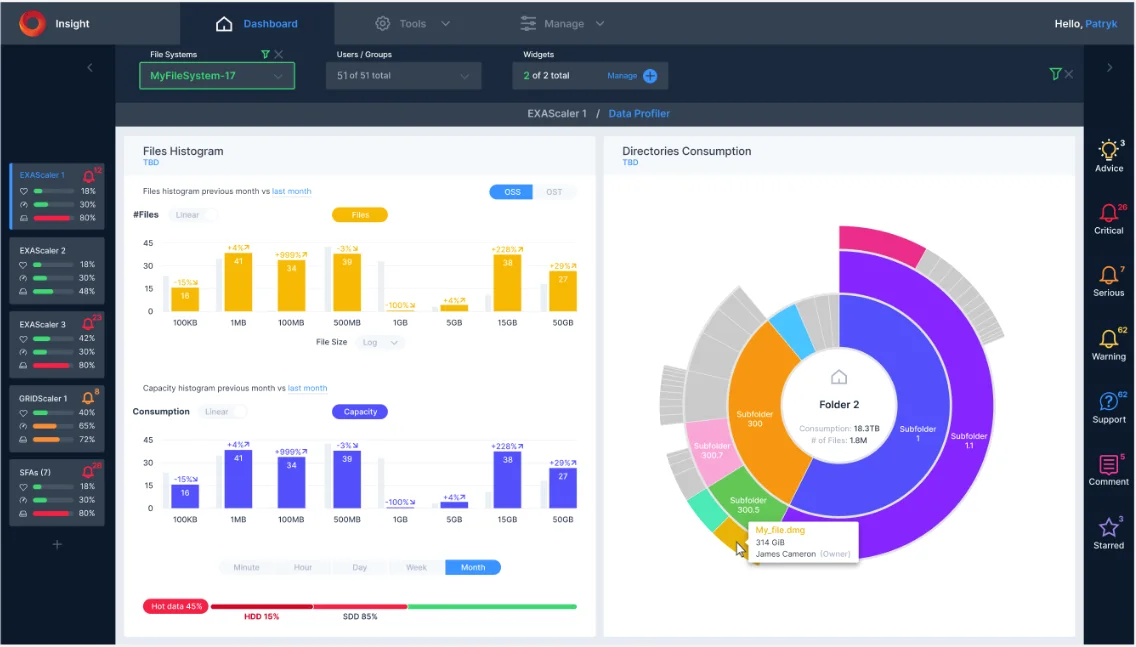
DDN’s Data Intelligence Platform pairs two products for AI and HPC data. Infinia is a software-defined, containerized storage system with native multi-protocol support and a key-value foundation, while EXAScaler is a parallel file system built on Lustre and enhanced by DDN. Together they form a data fabric spanning core, cloud, and edge environments.
Infinia provides multi-tenancy, metadata indexing, and sub-millisecond latency for AI inference, analytics, data preparation, and model loading, and integrates with frameworks such as NeMo, NIM microservices, Trino, and Spark. EXAScaler delivers multiple TB/sec throughput for large-scale training and checkpointing and is used in large GPU environments.
Key features include:
Limitations (as reported by users on Gartner Peer Insights):
Best for: Unified fast file and object storage for AI and HPC.
Strengths: Native NFS/SMB/S3 on one OS with non-disruptive upgrades.
Things to consider: High price and compression-only data reduction.
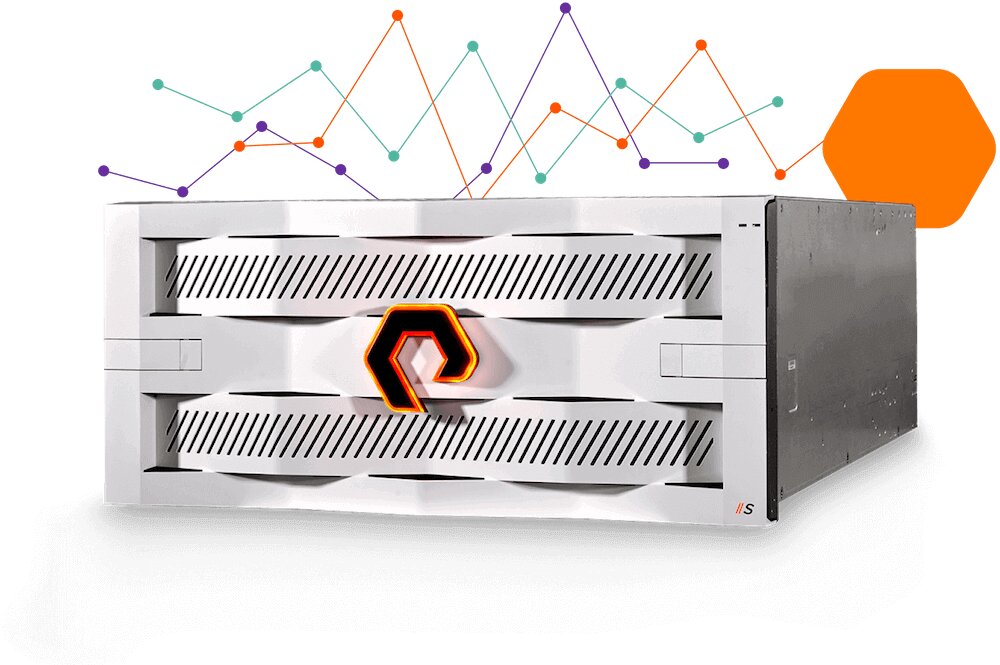
FlashBlade, from Everpure (the company formerly known as Pure Storage), is a unified, all-flash scale-out platform for unstructured data. It runs native NFS, SMB, and S3 on a single operating system, Purity//FB, without gateways or protocol forks, and uses a distributed metadata architecture to handle billions of files and objects.
The FlashBlade family spans FlashBlade//E for capacity-oriented repositories, FlashBlade//S for unified fast file and object, and FlashBlade//EXA for large-scale AI and HPC. Purity//FB adds SafeMode snapshots for ransomware defense, replication for distributed data, and Zero Move Tiering that places data by access pattern without moving it.
Key features include:
Limitations (as reported by users on PeerSpot):

Best for: Enterprise AI pipelines built on proven ONTAP data management.
Strengths: Disaggregated ONTAP, metadata engine, real-time ransomware detection.
Things to consider: Setup complexity, licensing cost, and CLI reliance.
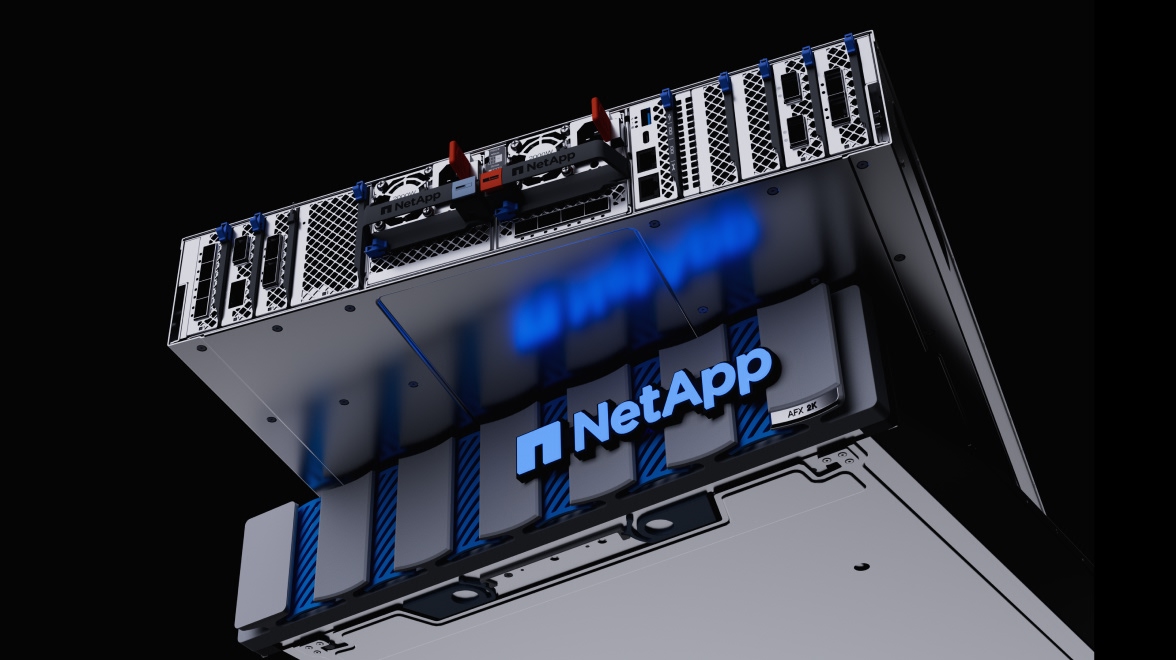
NetApp AFX is a disaggregated, all-flash data platform for enterprise AI, powered by NetApp ONTAP and certified for NVIDIA DGX SuperPOD. It decouples performance and capacity, scaling to 128 storage controllers and up to an exabyte of capacity, and supports pNFS, NFS, SMB, S3, and NFS/RDMA protocols.
AFX pairs with the NetApp AI Data Engine, an ONTAP-integrated service that indexes data, curates datasets, applies governance guardrails, and generates vector embeddings for retrieval-augmented generation. It carries ONTAP’s data management and security features and integrates across on-premises and hybrid multicloud environments.
Key features include:
Limitations (as reported by users on PeerSpot; AFX is built on the NetApp ONTAP platform, and the points below reflect that platform):
Storage systems for massive unstructured AI datasets must deliver far more than raw capacity. They need to combine scalable architectures, high throughput, low-latency access, efficient metadata management, strong security, and automated lifecycle management to keep pace with rapidly growing AI workloads. By selecting a platform that aligns with data volume, performance requirements, deployment model, and long-term operational costs, organizations can build a storage foundation that supports efficient model training, faster inference, and sustainable AI growth as datasets continue to expand.
See Cloudian first in Google Search

